
ATR-FTIR for Materials Research and Characterization
Attenuated Total Reflectance Fourier Transform Infrared (ATR-FTIR) spectroscopy is a valuable analytical technique for researchers studying surfaces, coatings, thin films, polymers, semiconductor materials, and optical substrates. By measuring the infrared absorption characteristics of a sample, ATR-FTIR can provide information about molecular bonding, functional groups, contamination, and changes in material chemistry.
For researchers working with silicon wafers and other semiconductor substrates, FTIR-based techniques can support investigations of surface treatments, dielectric films, organic residues, oxidation, and deposited materials.
Understanding the ATR Evanescent Wave
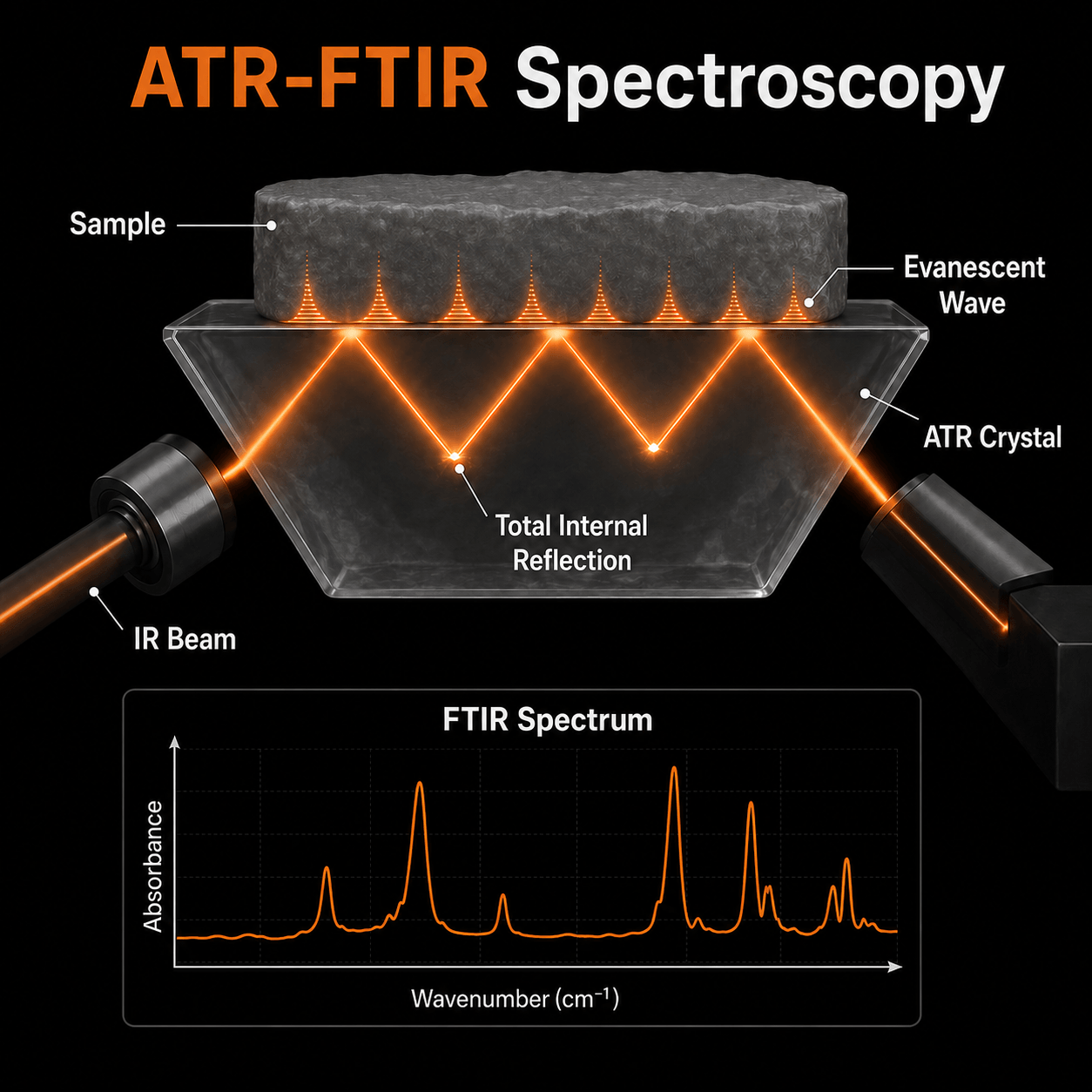
The key to an ATR measurement is the evanescent electromagnetic field generated when infrared radiation undergoes total internal reflection within the ATR crystal. This field extends beyond the crystal surface and interacts with the sample placed in direct contact with it.
The effective penetration depth is typically on the order of a fraction of a micrometer to several micrometers, depending on wavelength, angle of incidence, and the refractive indices of the ATR element and sample. Because of this shallow interaction region, ATR-FTIR is particularly useful for examining near-surface material chemistry.
ATR-FTIR Applications in Semiconductor Research
ATR and infrared spectroscopy can be useful when studying materials and processes used throughout semiconductor and materials-science research. Applications can include:
- Identifying organic residues and surface contamination
- Characterizing polymers and photoresist materials
- Studying chemical changes in thin films and coatings
- Comparing surfaces before and after chemical treatment
- Investigating oxidation and surface functionalization
- Evaluating bonding and chemical composition in research materials
Substrates for Thin-Film and Spectroscopy Research
UniversityWafer supplies substrates used by universities, laboratories, and research organizations for material characterization and thin-film experiments. Available materials include germanium wafers, zinc selenide (ZnSe), silicon nitride, and a wide selection of silicon substrates.
These substrates can support research involving infrared spectroscopy, thin-film deposition, surface modification, optical characterization, MEMS, semiconductor processing, and materials development.
Choose the Right Substrate for Your Research
Substrate material, surface finish, orientation, thickness, resistivity, and coating requirements can all influence an experiment. UniversityWafer can help researchers source wafers and substrates with specifications suited to their material characterization and spectroscopy research.
Need Wafers or Substrates for Your Research?
Tell us the material, diameter, thickness, orientation, quantity, and other specifications you need. We can help you find substrates for ATR-FTIR, thin-film, optical, and semiconductor research.
Get Your Research Substrate Quote FAST! Or, Buy Online and Start Researching Today!
How Does ATR-FTIR Spectroscopy Work?
Attenuated Total Reflectance (ATR) is a sampling technique commonly used with Fourier Transform Infrared (FTIR) spectroscopy to characterize the chemical composition of materials. Instead of transmitting infrared light directly through a sample, ATR directs the infrared beam through a high-refractive-index crystal.
When the infrared beam undergoes total internal reflection inside the ATR crystal, an evanescent wave extends a short distance beyond the crystal surface and into the sample. Molecules in contact with the crystal absorb specific infrared wavelengths, producing an FTIR spectrum that can be used to identify chemical bonds and functional groups.
ATR Crystal Materials
The choice of ATR crystal depends on the spectral range, sample properties, and experimental conditions. Common ATR materials include diamond, germanium, zinc selenide, and silicon.
- Germanium (Ge) – Its high refractive index produces a relatively shallow penetration depth, making it useful for surface-sensitive measurements and highly absorbing samples.
- Zinc Selenide (ZnSe) – A widely used infrared optical material suitable for many ATR and FTIR spectroscopy applications.
- Silicon – Silicon's infrared optical properties make it useful for specialized spectroscopy, optical, and semiconductor research.
- Diamond – Mechanically durable and chemically resistant, making diamond ATR elements useful when testing hard, abrasive, or chemically aggressive samples.
What Materials Can Be Analyzed with ATR?
ATR-FTIR can analyze a wide variety of solids, liquids, powders, polymers, thin films, coatings, and semiconductor-related materials. Because the technique primarily examines material close to the crystal/sample interface, it is especially useful for studying surfaces and coatings.
Researchers investigating silicon wafers, dielectric layers, polymers, optical materials, and deposited films can use infrared spectroscopy to study chemical composition, surface contamination, oxidation, and changes caused by material processing.
ATR-FTIR for Thin Films and Surface Research
ATR-FTIR can complement other surface and thin-film characterization methods. Researchers working with silicon nitride, silicon dioxide and thermal oxide, and other deposited materials may use FTIR spectroscopy to investigate bonding, chemical changes, and film composition.
Why Use ATR Instead of Transmission FTIR?
One of the main advantages of ATR is its minimal sample preparation. Samples can often be placed directly against the ATR crystal without first being made thin enough for transmission measurements. This makes ATR-FTIR particularly convenient for rapid laboratory characterization of bulk materials, surfaces, coatings, powders, and liquids.
For reliable measurements, good physical contact between the sample and the ATR crystal is important because the evanescent field only penetrates a small distance into the sample. Penetration depth depends on factors including wavelength, angle of incidence, and the refractive indices of the ATR crystal and sample.