What Substrates Are Used for Wide-Bandgap Semiconductors?
Wide-bandgap semiconductor substrates enable electronic and optoelectronic devices to operate at higher voltages, temperatures, switching frequencies, and power levels than conventional silicon. UniversityWafer supplies research-grade silicon carbide (SiC), gallium nitride (GaN), sapphire (Al2O3), aluminum nitride (AlN), diamond, calcium fluoride (CaF2), and fused silica substrates for power electronics, RF devices, ultraviolet photonics, laser technology, electric vehicles, renewable energy systems, and advanced semiconductor research.
Substrates for Wide-Bandgap Semiconductor Research
Researchers developing wide-bandgap semiconductors (WBGs) require high-quality substrates with excellent crystal quality, low defect density, and exceptional thermal stability. UniversityWafer supplies sapphire (Al2O3), calcium fluoride (CaF2), fused silica, silicon carbide (SiC), gallium nitride (GaN), and many other semiconductor substrates for power electronics, optoelectronics, RF devices, UV photonics, and advanced materials research.
A PhD researcher requested a quote for the following substrate specifications:
We need the following substrate specifications. These wafers will be used as substrates for sample production of wide-bandgap semiconductors doped with rare earth elements.
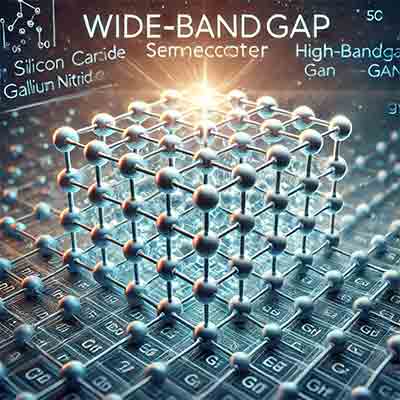
The diagram above illustrates the crystal structure, electronic band structure, and key material properties that distinguish wide-bandgap semiconductor materials from conventional semiconductors such as silicon. Materials including silicon carbide (SiC), gallium nitride (GaN), gallium oxide (Ga₂O₃), diamond, and aluminum nitride (AlN) enable devices that operate at significantly higher temperatures, voltages, frequencies, and power densities.
Diagram Highlights
Crystal Lattice Structure – Illustrates the hexagonal crystal arrangement commonly found in SiC and GaN, which contributes to their superior electrical and thermal performance.
Energy Band Structure – Shows the larger bandgap (typically 3–6 eV) compared with conventional semiconductors, allowing lower leakage currents and higher breakdown voltages.
Material Properties – Highlights important characteristics including high breakdown electric field, excellent thermal conductivity, low intrinsic carrier concentration, and reliable high-temperature operation.
Typical Applications – Demonstrates why wide-bandgap materials are widely used for power electronics, RF and microwave devices, ultraviolet LEDs, laser diodes, aerospace electronics, electric vehicles, and renewable energy systems.
Common Wide-Bandgap Materials – Includes Silicon Carbide (SiC), Gallium Nitride (GaN), Gallium Oxide (Ga₂O₃), Diamond, and Aluminum Nitride (AlN), each optimized for different semiconductor applications.
Wide-bandgap semiconductor substrates continue to drive innovation in electric vehicles, high-voltage power conversion, RF communications, 5G infrastructure, aerospace electronics, defense systems, ultraviolet photonics, and next-generation semiconductor manufacturing. Their superior electrical and thermal properties enable smaller, faster, and more energy-efficient electronic devices than conventional silicon technology.
What Are Wide-Bandgap Semiconductors?
Wide-bandgap semiconductors (WBGs) are advanced semiconductor materials with an energy bandgap significantly larger than conventional materials such as silicon (Si) and gallium arsenide (GaAs). Their wider bandgap allows electronic devices to operate at higher voltages, temperatures, frequencies, and power levels, making them essential for modern power electronics, RF communications, electric vehicles, aerospace systems, and renewable energy technologies.
Advantages of Wide-Bandgap Semiconductor Materials
Larger Bandgap Energy – Typically greater than 2.2 eV, compared to silicon's 1.12 eV.
High Temperature Operation – Stable performance in harsh environments with reduced leakage current.
Higher Breakdown Electric Field – Supports higher operating voltages while reducing device size.
High Power Density – Enables smaller, lighter, and more efficient power electronics.
Fast Switching Speeds – Reduces switching losses in high-frequency power conversion.
Excellent Thermal Conductivity – Materials such as silicon carbide (SiC) efficiently dissipate heat generated by high-power devices.
Improved Energy Efficiency – Lower conduction and switching losses increase overall system efficiency.
Common Wide-Bandgap Semiconductor Materials
Silicon Carbide (SiC)
Silicon carbide (SiC) has a bandgap of approximately 3.26 eV and is one of the most widely used wide-bandgap semiconductor materials.
Typical applications include:
Electric vehicle power modules
High-voltage MOSFETs
Power inverters
Industrial motor drives
Renewable energy systems
Smart electrical grids
Gallium Nitride (GaN)
Gallium nitride (GaN) has a bandgap of approximately 3.4 eV and is widely used for high-frequency and high-speed electronic devices.
Typical applications include:
5G and 6G communications
RF power amplifiers
HEMT devices
Blue and UV LEDs
Laser diodes
Satellite communications
Diamond
Diamond substrates possess an ultra-wide bandgap of approximately 5.5 eV, exceptional thermal conductivity, and excellent electrical performance for extreme environments.
Diamond is being investigated for:
Ultra-high-power electronics
Radiation-resistant electronics
High-temperature sensors
Advanced research devices
Aluminum Nitride (AlN)
Aluminum nitride (AlN) has one of the widest commercially useful bandgaps at approximately 6.2 eV.
AlN substrates are commonly used for:
Deep ultraviolet LEDs
UV laser diodes
RF electronics
High-frequency devices
Optoelectronic research
Applications of Wide-Bandgap Semiconductor Devices
Wide-bandgap semiconductor substrates support numerous advanced technologies across multiple industries.
Power Electronics – SiC MOSFETs and GaN HEMTs improve efficiency in electric vehicles, battery chargers, and industrial power systems.
Renewable Energy – Solar inverters, wind turbine converters, and energy storage systems benefit from lower power losses.
5G & RF Communications – GaN transistors provide high output power and high-frequency operation for wireless infrastructure.
Aerospace & Defense – High-temperature, high-radiation tolerance makes WBG materials ideal for satellites, radar, and military electronics.
Medical Equipment – Used in imaging systems, surgical lasers, and advanced diagnostic instruments.
Industrial Automation – Supports high-efficiency motor drives, robotics, and factory automation equipment.
Why Researchers Choose Wide-Bandgap Substrates
Researchers developing next-generation semiconductor devices often select sapphire, SiC, GaN, diamond, AlN, CaF2, and fused silica substrates because these materials provide superior electrical isolation, thermal stability, mechanical strength, and compatibility with advanced epitaxial growth techniques. These properties enable higher efficiency, greater reliability, and improved performance in demanding electronic and optoelectronic applications.