
Get Your Quote FAST!
Power your next innovation with precision substrates from UniversityWafer, Inc. Explore high-purity silicon wafers, SOI substrates, SiGe wafers, and specialty semiconductor materials for sense amplifiers, RF devices, MEMS, sensors, and advanced CMOS research.
Get Your Quote FAST! Or, Buy Online and Start Researching Today!
Semiconductor Substrates for Memory and RF Devices
Modern sense amplifiers rely on high-quality semiconductor substrates to support low-noise signal amplification, fast switching speeds, and reliable CMOS fabrication. Bulk silicon wafers remain the industry standard for DRAM and SRAM devices, while SOI, SiGe, sapphire, and RF semiconductor substrates are increasingly used in advanced sensing and high-frequency applications.
What is Bulk Silicon and Why Is It Used for Sense Amplifiers?
Bulk silicon refers to a solid, crystalline silicon wafer that serves as the foundation for fabricating integrated circuits (ICs). It is the most common and cost-effective material used in the semiconductor industry because it supports mature CMOS processing, high device density, and scalable manufacturing.
- Material: High-purity single-crystal silicon, typically grown using the Czochralski (CZ) or Float-zone (FZ) method.
- Crystal Orientation: Common orientations include <100>, <110>, and <111>.
- Wafer Sizes: Common diameters range from 100 mm to 300 mm.
- Resistivity: Lower resistivity is common for power devices, while higher resistivity silicon is often used for RF and low-loss semiconductor applications.
How Bulk Silicon Is Used to Fabricate Sense Amplifiers
Sense amplifiers used in DRAM, SRAM, and other memory devices are commonly fabricated with CMOS technology on bulk silicon wafers. The silicon substrate provides the base material where transistors, isolation regions, interconnects, and amplifier circuits are formed.
CMOS Process on Bulk Silicon
Sense amplifier circuits are created through standard semiconductor manufacturing steps such as oxidation, photolithography, doping, deposition, etching, and metallization.
| Step | Description |
|---|---|
| 1. Substrate Preparation | A bulk silicon wafer is polished to a mirror-like finish to serve as the device substrate. |
| 2. Oxidation | A thin silicon dioxide layer is grown on the wafer surface to provide electrical insulation. |
| 3. Photolithography | Circuit patterns are defined using UV exposure and photoresist processing. |
| 4. Doping | Specific regions are doped with impurities such as boron or phosphorus to form transistor regions. |
| 5. Deposition | Layers such as polysilicon, dielectric films, and metals are deposited. |
| 6. Etching | Unwanted material is removed to define transistor gates, contacts, and circuit features. |
| 7. Metallization | Metal interconnects are added to connect transistors and circuit components. |
| 8. Sense Amplifier Formation | Transistors are arranged into differential or cross-coupled latch configurations to form the sense amplifier. |
Why Bulk Silicon Is Used for Sense Amplifiers
Bulk silicon is widely used in semiconductor memory production because it provides a practical balance of cost, yield, electrical performance, and manufacturing maturity.
| Feature | Benefit for Sense Amplifiers |
|---|---|
| Low Cost | Bulk silicon wafers are more cost-effective than advanced substrates such as SOI. |
| Established Process | CMOS manufacturing on bulk silicon is mature, reliable, and widely available. |
| High Transistor Density | Supports dense integration of sense amplifiers into DRAM and SRAM memory arrays. |
| Good Electrical Properties | Provides reliable transistor behavior for standard memory and logic devices. |
Sense Amplifiers in Memory on Bulk Silicon
In DRAM and SRAM memory architectures, sense amplifiers are integrated into the bitline structure to detect small electrical differences and convert them into readable logic levels.
| Memory Type | Role of Sense Amplifier |
|---|---|
| DRAM | Reads tiny charge differences from a capacitor and amplifies them using a latch-based circuit. |
| SRAM | Detects the state of bistable memory cells by amplifying voltage differences between bitlines. |
Limitations of Bulk Silicon in Advanced Applications
While bulk silicon is excellent for standard memory and logic devices, some high-speed, low-power, and RF applications require substrates with better isolation or lower parasitic effects.
| Limitation | Impact |
|---|---|
| Parasitic Capacitance | Can reduce speed and efficiency in high-frequency or low-power circuits. |
| Latch-up Susceptibility | Bulk silicon circuits may be affected by parasitic transistor structures. |
| Substrate Noise | Signal coupling through the substrate can reduce analog and RF performance. |
For high-speed, low-power, or RF semiconductor applications, SOI wafers may be preferred because they improve isolation and reduce parasitic capacitance.
Need Research-Grade Silicon Wafers?
UniversityWafer supplies bulk silicon wafers, SOI substrates, SiGe wafers, and specialty semiconductor materials for DRAM, SRAM, RF, MEMS, and advanced CMOS research applications.
Buy Semiconductor Wafers Online or request a custom quote today.
What Is a Sense Amplifier and What Substrates Are Used to Fabricate It?
A Sense Amplifier is a semiconductor circuit designed to detect and amplify extremely small voltage or current differences in memory arrays, RF systems, sensors, and analog integrated circuits. Sense amplifiers are critical components in integrated circuits, CMOS image sensors, MEMS devices, biosensors, and RF thin-film semiconductor applications.
What Does a Sense Amplifier Do?
In semiconductor memory devices, stored electrical signals are extremely small and require amplification before they can be processed by digital circuitry.
-
Memory cells store data as electrical charges (DRAM) or bistable states (SRAM).
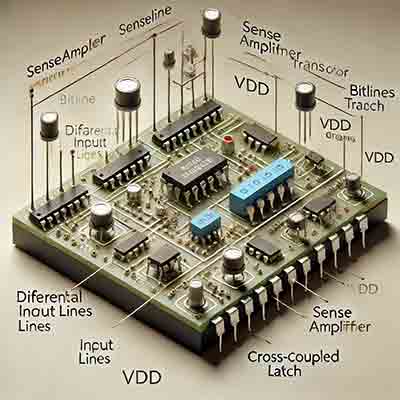
- The sense amplifier detects the small voltage difference between bit lines.
- The circuit amplifies the signal into a readable logic level (0 or 1).
- High-speed sensing improves memory access times and overall semiconductor performance.
Types of Sense Amplifiers
- Voltage Sense Amplifier – Measures voltage differences between bit lines.
- Current Sense Amplifier – Detects current differences in semiconductor circuits.
- Differential Sense Amplifier – Compares two signals and amplifies their difference for improved noise immunity.
- Charge Sense Amplifier – Commonly used in charge-based memory technologies such as DRAM.
Substrates Used to Fabricate Sense Amplifiers
Sense amplifiers are typically fabricated using silicon wafers and other semiconductor substrates compatible with CMOS fabrication processes. The substrate selection impacts speed, power consumption, noise isolation, and RF performance.
| Substrate Type | Description & Usage |
|---|---|
| Bulk Silicon | Most common for standard CMOS-based sense amplifiers in DRAM and SRAM devices. |
| Silicon-on-Insulator (SOI) | Improves switching speed and reduces parasitic capacitance for RF and low-power semiconductor devices. |
| Silicon Germanium (SiGe) | Used in specialized RF and high-frequency analog integrated circuits. |
| Silicon Carbide (SiC) | Used in high-temperature and radiation-resistant semiconductor applications. |
| GaAs / III-V Materials | Common in high-speed RF circuits, microwave electronics, and mmWave devices. |
Why SOI Wafers Are Important for RF and Low-Power Devices
SOI wafers are frequently used in RF semiconductor applications because they reduce parasitic effects and improve electrical isolation.
- Reduced parasitic capacitance for faster signal response
- Lower leakage current for improved power efficiency
- Better electrical isolation for RF integrated circuits
- Improved radiation resistance for aerospace electronics
- Enhanced GHz-frequency performance
Although SOI substrates offer significant advantages, bulk silicon remains the industry standard for most high-volume DRAM and SRAM manufacturing because of its low cost and mature CMOS fabrication processes.
Sense Amplifier Applications in Semiconductor Devices
Sense amplifiers are used in a wide range of semiconductor applications beyond memory arrays.
| Application | Role of Sense Amplifier |
|---|---|
| Memory (DRAM, SRAM) | Detects small charge and voltage differences on memory bit lines. |
| RF Circuits | Amplifies weak RF signals in LNAs and wireless communication systems. |
| Sensors & MEMS | Detects small electrical changes in biosensors, MEMS devices, and sensing platforms. |
Sense Amplifiers in RF Thin-Film Devices
RF thin-film semiconductor devices often require highly sensitive low-noise amplification circuitry. Sense amplifiers help improve signal integrity and reduce noise in microwave, mmWave, and RF sensing applications.
Applications include:
-
RF semiconductor devices
- MEMS sensors
- Low-noise amplifiers (LNAs)
- Microwave and mmWave electronics
- Biosensor signal detection
- Advanced thin-film sensing platforms
Substrates for RF Thin-Film Sense Amplifiers
| Substrate | Why It Matters for RF / Thin Film Devices |
|---|---|
| Bulk Silicon | Standard CMOS substrate but susceptible to substrate loss at high frequencies. |
| SOI | Reduces parasitic capacitance and improves RF isolation. |
| Porous Silicon | Emerging low-loss RF substrate for sensing and experimental thin-film devices. |
| Sapphire (Al2O3) | Excellent high-frequency performance and low RF loss for GaN HEMTs. |
| GaAs / InP | High-speed substrates used in microwave and mmWave RF electronics. |
| Silicon Carbide (SiC) | High-power substrate for radar systems and power amplifiers. |
Sense Amplifier Performance Factors in Semiconductor Devices
The performance of a sense amplifier depends heavily on substrate quality, transistor design, and parasitic effects within the semiconductor structure. Engineers optimize sense amplifier layouts to improve signal integrity, reduce propagation delay, and minimize electrical noise.
Important performance factors include:
- Bitline capacitance
- Leakage current
- Transistor matching
- Offset voltage
- Noise margin
- Signal integrity
- Propagation delay
- Power consumption
Researchers frequently use silicon wafers, SOI substrates, SiGe wafers, and SiC substrates for advanced semiconductor memory, RF sensing, and CMOS fabrication research.
Sense Amplifier FAQ
What is a sense amplifier?
A sense amplifier is an electronic circuit used to detect and amplify very small voltage or current differences in semiconductor devices.
What substrates are used for sense amplifiers?
Common substrates include bulk silicon, SOI wafers, SiGe substrates, sapphire, GaAs, and silicon carbide.
Why are SOI wafers used in RF applications?
SOI wafers reduce parasitic capacitance and improve signal isolation, making them ideal for RF and low-power semiconductor devices.
Are sense amplifiers used in DRAM and SRAM?
Yes. Sense amplifiers are essential components in DRAM and SRAM memory arrays because they detect small electrical changes stored in memory cells.
Can sense amplifiers be used in MEMS sensors?
Yes. MEMS devices and biosensors often use sense amplifiers to detect and amplify weak electrical signals.
Request Semiconductor Substrates for Sense Amplifier Research
UniversityWafer supplies research-grade silicon wafers, SOI substrates, SiGe wafers, sapphire, GaAs, and RF semiconductor materials for memory devices, RF amplifiers, sensors, and advanced CMOS fabrication.
Get Your Quote FAST! Or, Buy Online Today .