
“We are looking for substrates for infrared spectroscopy measurements. Please send us a quotation for five CaF2 wafers with approximately 1 mm thickness and large diameters suitable for cutting into smaller samples.”
CaF2 Wafers for Infrared Spectroscopy
UniversityWafer supplies CaF2 wafers, silicon substrates, and other infrared transparent materials for FTIR measurements, infrared spectroscopy, optical coating research, and semiconductor characterization applications.
A PhD researcher requested the following:
For infrared spectroscopy applications, researchers commonly select:
- Calcium fluoride (CaF2)
- High resistivity silicon
- Float zone silicon
- Germanium wafers
- ZnSe substrates
- Fused silica wafers
Reference #122834 for specifications and pricing.
Get Your Infrared Material Quote FAST! Or, Buy Online today!
Silicon Substrates for FTIR Spectroscopy
A graduate student requested assistance selecting a suitable silicon substrate for FTIR (Fourier Transform Infrared) spectroscopy experiments involving near-infrared and mid-infrared wavelength analysis.
“I would like to know which silicon substrate can be used for FTIR spectroscopy and general spectroscopy applications. I believe I may need a double side polished silicon substrate, but I am unsure which type works best for near-infrared to mid-infrared experiments.”
UniversityWafer Recommended:
For FTIR spectroscopy and infrared transmission measurements, researchers typically use high purity double side polished silicon wafers because polished surfaces minimize scattering and improve optical transmission quality.
The most commonly requested substrates include:
- Intrinsic (undoped) silicon wafers
- High resistivity silicon wafers
- Float zone (FZ) silicon wafers
- Prime-grade DSP silicon substrates
- Thin silicon wafers for IR transmission studies
Float zone silicon is often preferred because it contains significantly lower oxygen and carbon impurity concentrations than Czochralski (CZ) silicon, resulting in improved infrared transparency and reduced absorption losses.
Important FTIR Substrate Considerations
-
Infrared Transparency: Silicon is transparent in selected near-infrared and mid-infrared wavelength ranges, making it useful for transmission-based spectroscopy experiments.
-
Surface Roughness: Double side polished silicon wafers minimize scattering and improve spectral measurement accuracy.
-
Substrate Thickness: Thinner wafers can reduce optical absorption losses and improve IR transmission performance.
-
Doping: Undoped or high resistivity silicon is commonly preferred to minimize free carrier absorption effects.
Reference #132068 for specifications and pricing.
Far Infrared Spectroscopy
A chemical engineering PhD researcher requested high resistivity silicon wafers for far infrared spectroscopy studies.
“I am looking for high resistivity silicon wafers for far infrared spectroscopy. Float zone purified wafers may be best, but low-doped substrates could also work. Thinner wafers are preferred.”
For far infrared spectroscopy, researchers commonly request:
- High resistivity silicon wafers
- Float zone purified silicon
- Thin DSP silicon substrates
- Low impurity semiconductor wafers
- Infrared transparent substrates
High resistivity float zone silicon is widely used for IR optics, FTIR analysis, detector research, thin film characterization, and semiconductor spectroscopy because of its low impurity content and improved infrared transmission properties.
Reference #170919 for specifications and pricing.
Silicon Wafers for Transmission-Based Infrared Spectroscopy
A graduate researcher requested assistance selecting double side polished silicon wafers for transmission-based infrared spectroscopy studies involving nanometer-scale thin film deposition and IR transparency.
“I wanted to know if a certain DSP Prime Silicon wafer from your company is infrared transparent. We are performing transmission-based infrared spectroscopy studies and require low surface roughness for nanometer-level deposition.”
UniversityWafer, Inc. Recommended:
For infrared spectroscopy applications, Float Zone (FZ) silicon wafers are typically preferred over Czochralski (CZ) silicon because the FZ crystal growth process produces significantly lower oxygen and carbon impurity concentrations. Lower impurity levels improve infrared transmission and reduce unwanted absorption peaks in IR spectroscopy measurements.
For FTIR and transmission-based IR analysis, researchers commonly use:
- High-resistivity silicon wafers
- Double side polished (DSP) silicon substrates
- Undoped float zone silicon
- Low surface roughness wafers for thin film deposition
- Prime-grade semiconductor substrates
Reference #312742 for specifications and pricing.
What is Infrared (IR) Spectroscopy?
Infrared spectroscopy is an analytical technique used to study how molecules absorb infrared radiation. It is widely used in chemistry, semiconductor research, thin film characterization, photovoltaics, optics, and materials science.
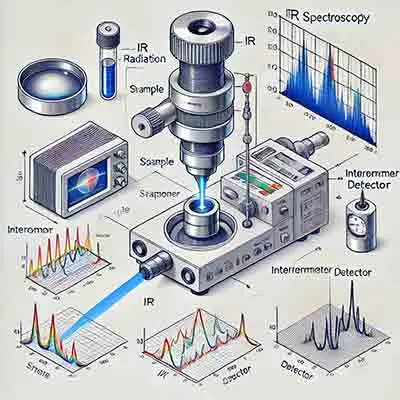
When infrared radiation interacts with a material, molecular bonds absorb specific wavelengths that correspond to vibrational modes such as stretching and bending. The resulting IR spectrum can be used to identify functional groups, analyze thin films, evaluate material purity, and characterize semiconductor coatings.
Common Applications of IR Spectroscopy
- Thin film characterization
- Semiconductor process analysis
- FTIR material identification
- Nanotechnology research
- Optical coating analysis
- Photovoltaic material studies
- Surface contamination detection
- Chemical composition analysis
FTIR Spectroscopy Systems
Fourier Transform Infrared (FTIR) spectrometers are widely used because they provide high sensitivity, improved signal-to-noise ratio, and fast spectrum acquisition. FTIR systems are commonly used in semiconductor laboratories, research institutions, and optical coating facilities.
Infrared Transparent Silicon Wafers
High-resistivity silicon wafers are commonly used for infrared transmission applications because silicon exhibits strong IR transparency in selected wavelength regions. For semiconductor and optical research, high-resistivity silicon and float zone silicon wafers are frequently selected to minimize free carrier absorption and impurity-related spectral interference.
A scientist requested the following specification:
“I need silicon wafers with high infrared transmittance in the wavelength range of 5–14 microns for IR transmission studies.”
UniversityWafer recommended:
- High resistivity >100 Ohm-cm
- Double side polished surfaces
- Square silicon wafers
- Float zone crystal growth
- Low oxygen and carbon content
Reference #266522 for specifications and pricing.
Substrates Used for GD Spectrometry
Glow discharge spectrometry (GD-OES) and depth profiling applications require large, high-purity substrates with excellent surface quality and composition control.
“We perform GD spectrometry for elemental depth profile analysis and require large substrates suitable for multiple analysis spots.”
For GD spectrometry and thin film characterization, commonly requested substrates include:
- Cadmium Telluride (CdTe)
- Double side polished silicon wafers
- High purity intrinsic silicon
- High resistivity silicon
- Large diameter silicon substrates
- Photovoltaic material wafers
Researchers often prefer 4-inch, 6-inch, and 8-inch silicon wafers because larger substrates allow multiple destructive analysis spots while maintaining calibration consistency.
Recommended Wafer Properties for GD-OES
- Large substrate area
- Low impurity concentration
- Double side polished surfaces
- Controlled thickness uniformity
- Known composition and resistivity
- Stable surface roughness
Reference #134413 for specifications and pricing.