Silicon Carbide-on-Insulator (SiCOI) Substrates
SiCOI wafers (Silicon Carbide-on-Insulator wafers) are advanced composite substrates engineered by bonding a thin silicon carbide (SiC) layer to a high-quality insulating layer. This specialized structure is widely used in photonic integrated circuits (PICs), microelectromechanical systems (MEMS), and other high-performance semiconductor applications. By combining the superior mechanical, thermal, and electrical properties of silicon carbide with the excellent isolation characteristics of an insulator, SiCOI wafers deliver improved device performance, reduced signal loss, and enhanced reliability — making them an ideal choice for next-generation electronic, photonic, and optoelectronic devices.
Silicon Carbide Thin Film on Quartz Substrate
A Ph.D. Student requested a quote for the following.
We bought some silicon carbide films on glass from you and they worked well. Can we order 380 nm silicon carbide thin film on quartz substrate? Can we order this by wafer or by deposition run? Can we order a single 4 inch wafer of this thin film on quartz substrate?
For the substrate, we want 100 mm in diameter, 500 microns thick, DSP, single crystal Quartz, then we want 380 nm thick sputtered silicon carbide deposited on this quartz substrate. Could you please let me know how many we can order at least? Can we order just one or two wafers? If yes, can you please send me a quote for two 380 nm silicon carbide coated quartz wafers?
Reference #224298 for specs and pricing.
SiC-on-Insulator (SiCOI) Wafers
An electrical engineer requested a quote for the following
I‘d like to inquire about the pricing options for different SiCOI wafers, could you please send a quote to us? Additionally, would it be possible to purchase a small sample piece initially for testing before committing to a full wafer purchase? I look forward to your quick response and appreciate your assistance.
Reference #317290 for specs and pricing.
Get Your FAST! Or, Buy Online and Start Researching Today!
4H-SiCOI for Integrated Photonic Device Fabrication
A PhD Candidate requested a quote for the following.
Hi do you have SiCOI wafers? I want to use the silicon carbide for integrated photonic components and devices such as waveguides and ring resonators. Therefore, I am quite interested in the 4H silicon carbide on insulator (4H-SiCOI) wafers, which has 4H-SiC thin films on top of the SiO2 on Si carrier wafers. I have read that one approach to get this kind of wafers is to bond the 4H-SiC wafers with the SiO2 on Si carrier wafers and then to grind the 4H-SiC wafers down to the thickness of several microns. I wonder whether you can provide such a kind of wafers. The diameter can either be 4-inch or 2-inch based on your inventory. The type of 4H-SiC wafer should be insulating with 0-deg off axis. The thermally grown SiO2 should at least be 1um thick with good surface conditions
Reference #277843 for specs and pricing.
Silicon Carbide on Insulator
A PhD candidate requested a quote for the following.
I am writing to purchase some 4Hydrogen-Silicon Carbide on Insulator (4H-SiCOI) wafer whose size is 4-inch, the detailed scheme is shown in below. Thickness of SiC should
be 5~ 50um; thickness of SiO2 should be 1~4um; lastly Si layer, as a handle layer, if thickness >200 um still OK for me. If there are any stocks in your company, could you give me optional detailed parameter list about this?
Reference #266877 for specs and pricing.
What Is SiC-on-Insulator (SiCOI) Substrates
SiC-on-Insulator (SiCOI) substrates are a type of semiconductor material that consist of a thin layer of silicon carbide (SiC) deposited on an insulating substrate, often silicon dioxide (SiO2), similar to the way Silicon-on-Insulator (SOI) substrates are structured. These substrates are designed to combine the advantageous properties of SiC with the benefits of an insulating layer.
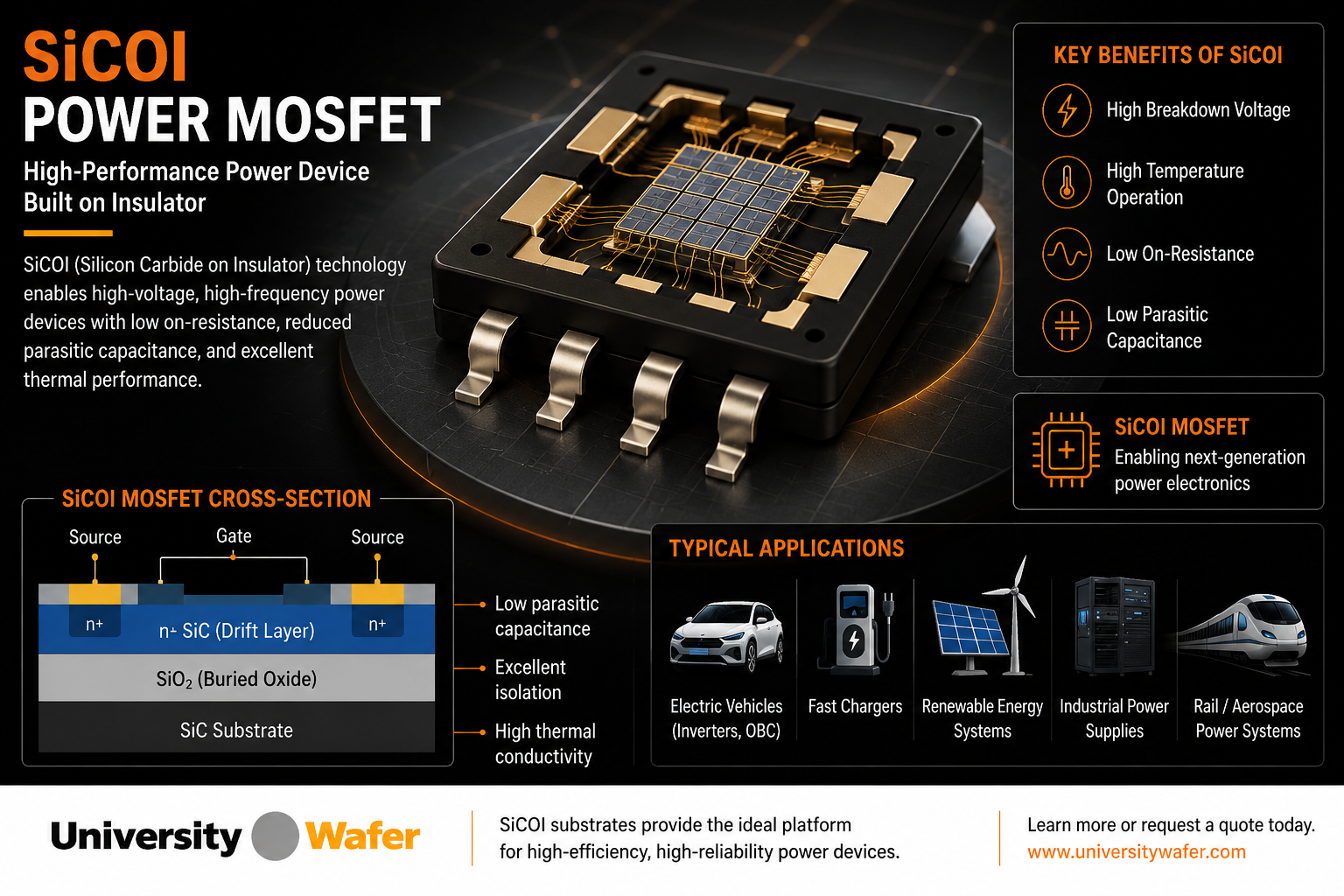
Key Features of SiCOI Substrates:
- High Thermal Conductivity: SiC has excellent thermal conductivity, making it ideal for high-power and high-temperature electronic devices.
- Wide Bandgap: SiC is a wide-bandgap semiconductor, which allows for devices to operate at higher voltages, temperatures, and frequencies compared to traditional silicon.
- Electrical Isolation: The insulating layer beneath the SiC layer improves electrical isolation between devices, reducing parasitic capacitance and leakage, and enhancing device performance.
- Reduced Power Losses: SiCOI substrates can help minimize power losses, particularly in power electronics and radio-frequency (RF) devices, by reducing heat generation and improving efficiency.
- Mechanical Strength: SiC has excellent mechanical strength and chemical resistance, making it suitable for harsh environments, such as automotive, aerospace, and industrial applications.

Advantages of SiCOI Wafers
1. Electrical Isolation
The buried insulator significantly reduces parasitic capacitance and leakage currents. This improves RF device efficiency and enables densely integrated circuits.
2. Reduced Optical Loss for Photonics
SiCOI substrates support low-loss SiC waveguides, enabling applications in:
-
Nonlinear photonics
-
Frequency combs
-
Integrated lasers
-
Mid-IR photonics
-
Quantum emitters
3. Better Thermal Management
SiC naturally exhibits high thermal conductivity, helping dissipate heat more effectively than silicon-based platforms.
4. Higher Reliability for MEMS
The strong SiC device layer:
5. Ideal for Harsh Environments
SiCOI devices can operate in extreme temperatures, corrosive chemistry, and high-radiation environments better than traditional materials.
Common Applications
✔ Photonic Integrated Circuits (PICs)
SiCOI is rapidly becoming a leading platform for:
✔ MEMS & RF MEMS
SiCOI wafers improve device strength and lifetime for:
SiC hosts multiple quantum emitters and color centers that benefit from the optical confinement achievable on SiCOI.
✔ High-Frequency and High-Power Electronics
Although not as common as SOI, SiCOI is useful for:
These substrates are emerging in research and industry because they offer a unique combination of the insulating benefits of SOI and the high-performance characteristics of SiC.
Typical SiCOI Wafer Specifications
Below are common parameters researchers request:
| Parameter |
Typical Range |
| SiC Layer Material |
3C-SiC, 4H-SiC, 6H-SiC |
| SiC Thickness |
100 nm – 2 µm |
| Buried Oxide Thickness |
100 nm – 3 µm |
| Handle Substrate |
Si, sapphire, or alternative insulators |
| Diameter |
100 mm, 150 mm (most common) |
| Surface Finish |
CMP-polished (single- or double-sided) |
UniversityWafer can fabricate custom specifications based on research needs.
SiCOI vs SOI vs Bulk SiC
| Feature |
SiCOI |
SOI |
Bulk SiC |
| Wide Bandgap Material |
Yes (SiC) |
No |
Yes |
| Electrical Isolation |
Excellent |
Excellent |
Limited |
| Optical Loss |
Very low |
Moderate |
Very low |
| High-Temp Performance |
Excellent |
Limited |
Excellent |
| Cost |
Higher |
Moderate |
High |
SiCOI presents a unique hybrid advantage — isolation + wide bandgap — which neither SOI nor bulk SiC can offer simultaneously.
SiCOI Transparent in the Far-Infrared
A senior research scientist requested help with the following.
We need undoped SiC, transparent in the far-IR but I cannot quantify the residual allowable doping/resistivity yet. We'll get back after some research. If you had any list at hand we could look more specifically an the available items and price to see if they look promising. We could by a sample to run it on a spectrometer.
Reference #162283 for specs and pricing.
Related SiCOI, SiC & Semiconductor Resources
