
Semiconductor Materials Characteristics
As of today, Silicon (Si) is still the most important material used in Silicon. Silicon wafers are used to fabricate devices. Si's unique physical and chemical properties provide the semiconductor industry with a cheap and abundant supply.
Get Your Quote FAST! Or, Buy Online and Start Researching Today!
Silicon's Atomic Structure
Silicon's atomic structure includes the following:
- Electrons
- Protons
- Neutrons
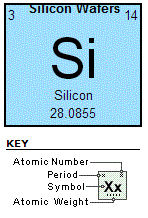 Silicon, although abundant, is not found in pure form. Si must be purified by refining it.
The melting point of Silicon 1412 deg C.
Pure Silicon is called Intrinsic Silicon and it has no impurities.
An example of Intrinsic Silicon specs are as follows:
100mm Intrinsic FZ Si (100) >20,000 ohm-cm 500um SSP
Silicon makes up around 85% of the material used in Semiconductors. But why Silicon and not another material?
Melting Points of Different Semiconductor Materials
Property |
Si |
Germanium |
GaAs |
SiO2 |
|---|---|---|---|---|
| Melting Point Celcius | 1412 | 937 | 1238 | ~1700 |
| Atomic Weight | 28.09 | 72.6 | 144.63 | 60.08 |
| Atomic density (atoms/cm3) | 4.00 x 10 to the 22 | 4.42 x 10 to the 22 | 2.21 x 10 to the 22 | 2.3 x 10 to the 22 |
| Energy Band GaP (eV) | 1.11 | 0.67 | 1.40 | ~8 |
Why Use Silicon in Semiconductors?
Below are the main reasons why Silicon and not Germanium, the first semiconductor, is used in semiconductors.
- Silicon is the second most abundant material on earth after carbon. Silicon
 makes up 25% of the earth crust.
 - Silicon has a higher melting point to withstand higher processing temps.
- Silicon has a wider range of temperatures that it can function under. So from cold to hot, Silicon performance surpasses most other materials such as Germanium.
- Silicon dioxide (SiO2) grows naturally on the surface of Silicon Wafers. SiO2 is stable insulator required in semiconductors. The mechanical properties of SiO2 means you can process the wafer at high-temp without the wafer warping.
Doping Silicon
No only can Silicon be purfied to make it Intrinsic (undoped), silicon can also be doped to create Extrinsic Silicon.
So extrinsic silicon is impure. But it's done on purpose to increase semiconductor conductivity.
Adding impurities or doping can change the electrical conductivitiy of the semiconductor.
Doped Silicon Resistivity
Doping pure silicon reduces resistivity while it improved conductivity.
Silicon P-N Junctions
The heart of solid-state electronics is the pn junction. P-N junctions and is the reason why semiconductors can act as both an insulator and as a conductor.
What Types of Semiconductors Are There?
Semiconductors are typically classified into the following main types, based on material composition and doping characteristics:
🔹 1. Intrinsic Semiconductors
-
Definition: Pure semiconductor materials without any significant impurities.
-
Examples: Pure silicon (Si), germanium (Ge).
-
Properties:
-
Equal number of electrons and holes.
-
Electrical conductivity increases with temperature.
-
Used primarily in research and high-precision applications.
-
🔹 2. Extrinsic Semiconductors
-
Definition: Semiconductors whose conductivity is controlled by intentional doping with impurities.
-
Types:
-
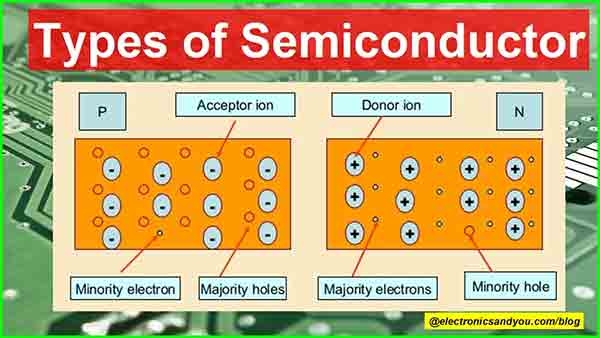
N-type: Doped with elements that have extra electrons (e.g., phosphorus, arsenic in Si). Electrons are majority carriers.
-
P-type: Doped with elements that have fewer electrons (e.g., boron, gallium in Si). Holes are majority carriers.
-
🔹 3. Elemental vs. Compound Semiconductors
a. Elemental Semiconductors
-
Made from a single element.
-
Examples: Silicon (Si), Germanium (Ge), Tin (Sn in specific forms like gray tin).
b. Compound Semiconductors
-
Made by combining two or more elements.
-
Examples:
-
III-V compounds: Gallium Arsenide (GaAs), Indium Phosphide (InP)
-
II-VI compounds: Zinc Selenide (ZnSe), Cadmium Telluride (CdTe)
-
IV-IV compounds: Silicon Carbide (SiC)
-
🔹 4. Organic Semiconductors
-
Made of carbon-based compounds.
-
Used in OLED displays, organic solar cells, and flexible electronics.
-
Examples: Polyacetylene, Pentacene, P3HT.
🔹 5. Amorphous Semiconductors
-
Non-crystalline form; atoms are not arranged in a regular pattern.
-
Example: Amorphous silicon (a-Si), used in thin-film solar cells and LCDs.
🔹 6. Wide Bandgap Semiconductors
-
Have a larger energy bandgap (>2 eV).
-
Can operate at high power, temperature, and frequency.
-
Examples: Silicon Carbide (SiC), Gallium Nitride (GaN), Diamond
| Type | Examples | Key Properties | Typical Applications |
|---|---|---|---|
| Intrinsic | Pure Si, Ge | Pure; equal electrons and holes | Research, temperature studies |
| N-type (Extrinsic) | Si doped with Phosphorus (P), Arsenic (As) | Extra electrons; electrons = majority carriers | Digital electronics, solar cells |
| P-type (Extrinsic) | Si doped with Boron (B), Gallium (Ga) | Extra holes; holes = majority carriers | Power devices, ICs |
| Elemental | Silicon (Si), Germanium (Ge) | Single element materials | Base material for ICs and microelectronics |
| Compound (III-V, II-VI, IV-IV) | GaAs, InP, SiC, CdTe | Made from multiple elements; varied properties | LEDs, lasers, solar cells, RF devices |
| Organic | Pentacene, P3HT, Polyacetylene | Flexible, carbon-based; used in organic electronics | OLEDs, organic solar cells, wearable tech |
| Amorphous | Amorphous Silicon (a-Si) | Non-crystalline; used in thin-film applications | LCDs, solar cells |
| Wide Bandgap | SiC, GaN, Diamond | High thermal, power, and frequency tolerance | EVs, RF, power electronics, aerospace |
Semiconductor Mechanical Materials Properties
The mechanical properties of semiconductors determine the electronic and optical properties, which are still the subject of extensive investigations. In order to limit and exploit impurities, atoms and crystal defects, it is necessary to develop a method for producing satisfactory semiconductor materials, which forms the basis for the development of so-called "semiconductor material technology." Due to the required level of perfection of the crystal structure required for the manufacture of semicurate components, special methods have been developed to produce the first semicodelectric materials. [Sources: 1, 5, 13]
This method, in which a thin film of semiconductors is layered on a heat-sensitive substrate material, offers the possibility of triggering changes in the properties of the semiconductor material electronically. It offers a new way to electronically trigger the change in the properties of semicodelectric materials, such as the absorption of light and the heat transfer from the surface to the subatomic plane. This method, which involves placing thick - or thin - chip layers over a heat-sensitive substrate, offers an alternative to conventional methods that electronically trigger the change in the property of a half-hearted material: the use of high-temperature heat. [Sources: 10]
The special properties of a semiconductor are determined by the materials used and the layering of these materials in the device. The size and characteristic parameters of semiconductors in a material have a significant influence on their properties, such as the absorption of light and heat transfer from the surface to the subatomic plane. [Sources: 9, 13]
The doping of a semiconductor, such as silicon, increases the number of free electrons (holes) in the semiconductors considerably. In this case, it can be said that by adding trivalent impurities (atoms) to the inner silicon semiconductor material, the number of current carriers can be increased and the conductivity of the silicon material can be improved. An intrinsic semicode electrical material can also be doped, so that it has more holes. By adding more free electron hole contamination, this can not only increase the number of holes, but also in some ways increase, in some cases even decrease, the number of electrons. [Sources: 1, 6]
The main property of an intrinsic semiconductor is the number of holes (electrons) that pass the current in this type of semiconductor. [Sources: 7]
Semiconductors doped with quintuple atoms are semiconductors of type n, because they are all holes, but if they are electrons, then they are p-types of semiconductors. Semiconductors dosed with trivalent atoms are not n-types of sediments because they do not carry electricity as negatively charged electrons (they have charge carriers known as electrons and holes). N semiconductors are extrinsic semic conductors in which the dopant atom is able to provide an additional conductive electron. The specific properties of these chips depend heavily on their impurities (doping), but the specific properties of each semicurate strongly depend on its impurities, or "doping agents." [Sources: 2, 6, 11]
This is used to produce n-like semiconductor materials that add electrons to the conductor band, increasing the number of electrons. [Sources: 0]
Composite semiconductors have properties that are useful for electronic devices and devices. They offer a wide range of properties such as high power, low power consumption, high conductivity and high electrical conductivity. [Sources: 12]
The main reason why semiconductor materials are so useful is that the behavior of semiconductors can be easily manipulated by adding impurities known as doping. The electronic properties and conductivity of a half-curate are modified in a controlled way by adding other elements, so-called doping, to the intrinsic material. Intrinsic properties can also be found in doped elements and even other elements that have been "doped" when introducing other desired properties. [Sources: 1, 3, 4]
A small amount of five-fold impurities is added to a pure semiconductor, resulting in extrinsic N-type semiconductors. Small amounts of trivalent impurities were added to pure silicon and its inner material in a small number of ways to produce P-type semiconductors, extrinsic conductors such as P-2, N-1 and S-3. Low doping can also cause a large increase in the electrical conductivity of the material, for example by adding small amounts of p-4, P1 and P2. [Sources: 15]
Chapter 3 shows how these phenomena can be applied to elementary compounds in semiconductors and offers a new approach to understanding the plasticity of semiconductor materials. Volume 1 begins with an overview of the elastic properties of all semic conductors, including elementary compounds and pseudobinary alloys of a semic conductor, and a description of their properties. [Sources: 5]
The aim of this volume is to describe the role that semiconductors have played in modern semiconductor technology. To understand the properties of semiconductor materials, we should know the basics that are related to them. Semiconductor materials have electrical conductivity values that fall into three main categories: high, medium and low - conductive. [Sources: 5, 7, 14]
The proportion of major impurities in each atom can be less than one in ten billion, and in fact the greatest values of the dielectric constant are between 0.1 and 1.5 parts per billion in high-purity materials. Germanium - Silicon is the purest semiconductor material you can get. It is one of the most common semiconductor materials used in optical detectors and is a good candidate for the development of optical sensors such as optical microscopes. [Sources: 8, 9, 13]
Sources:
[0]: https://asdn.net/asdn/physics/semiconductor.php
[1]: https://www.newworldencyclopedia.org/entry/Semiconductor
[2]: https://courses.lumenlearning.com/introchem/chapter/semiconductors/
[3]: https://metallurgyfordummies.com/semiconductor-materials.html
[5]: https://authors.library.caltech.edu/49710/
[6]: https://www.circuitbread.com/tutorials/basics-of-semiconductors
[7]: https://pnpntransistor.com/semiconductor-properties-types-uses/
[8]: https://encyclopedia2.thefreedictionary.com/Semiconductor+materials
[9]: http://www.tpub.com/neets/tm/111-2.htm
[10]: https://phys.org/news/2016-10-semiconductor-properties-room-temperature.html
[11]: https://energyeducation.ca/encyclopedia/Semiconductor
[12]: https://www.globenewswire.com/news-release/2020/06/10/2046424/0/en/Compound-Semiconductor-Materials-Market-To-Reach-USD-66-66-Billion-By-2027-Reports-and-Data.html
[13]: https://www.utmel.com/blog/categories/semiconductor/semiconductor-materials-types-properties-and-production-process
[14]: https://en.wikipedia.org/wiki/Semiconductor
What is the behavior of semiconductors?
Listed below are some basic facts about the materials used in semiconductors, such as the type of electrons in the material, the presence of a covalent bond, and the absorption rate. These facts should help you understand how the properties of semiconductors are affected by electric fields. To begin with, let's look at the difference between crystalline and amorphous silicon. Amorphous silicon is much more absorbent than crystalline silicon.
n-type semiconductors have an excess of electrons
A n-type semiconductor is an electrically neutral material with an excess of 'free' electrons. These electrons move freely within the crystal lattice due to the presence of immobile donors, such as nuclear protons and lower-band atoms. Free electrons are created by donating an ion from an impure atom, leaving a positive charge on the donor atom. A free electron is not always electrically neutral, so it is important to understand why n-type semiconductors are sometimes not completely neutral.
| Semiconductor | Density [g/cm³] | Z | Egap [eV] | ε [eV] | X0 [cm] |
|---|---|---|---|---|---|
| Si | 2.33 | 14 | 1.12 | 3.6 | 9.37 |
| Ge | 5.33 | 32 | 0.67 | 2.9 | 2.30 |
| CdTe | 5.85 | 48, 52 | 1.44 | 4.43 | 1.52 |
| CdZnTe | 5.81 | — | 1.60 | 4.6 | — |
| HgI₂ | 6.40 | 80, 53 | 2.13 | 4.2 | 1.16 |
| GaAs | 5.32 | 31, 33 | 1.42 | 4.3 | 2.29 |
Phosphorus, Arsenic, and Niobium are all elements that are able to donate an electron. These elements can be used to dope silicon, diamond, and other n-type semiconductors. While these naturally-occurring semiconductors are poor conductors, they can be doped with a donor element to produce a better semiconductor material. In addition to Niobium, other elements, such as Antimony or Arsenic, can also dop semiconductors.
In an n-type semiconductor, electrons move left to right through the crystal lattice, much like electrons move in a metallic wire. The electrical field moves electrons from a p-type region to an n-type region and vice versa. The p-n junction is formed when an excess of electrons in one semiconductor causes an excess of electrons in another. This causes electrons to diffuse from a high concentration region to a low-concentration region. When this happens, a restoring electric field is created, balancing the movement of electrons.
Another difference between n-type and p-type semiconductors is the presence of donor impurities. Donor impurities donate negatively charged electrons to semiconductors. The result is that the amount of electrons in an n-type semiconductor is greater than that of the p-type. As a result, electrons are the majority and holes are the minority carriers. This difference is necessary to understand how semiconductors work in electronic circuits.
Amorphous silicon is more absorbent than crystalline silicon
Amorphous silicon is a much more absorbent material than crystalline silicon, and the difference is quite dramatic. Amorphous silicon has been the subject of intense research over the past decade. It has been used for low-cost photovoltaic solar cells, electronic devices, displays, and imaging optical sensors. Its popularity in the photovoltaic industry has fueled research into using amorphous silicon in detectors.
In order to make solar cells, amorphous silicon is more absorbent than a crystalline counterpart. Its atoms are arranged randomly and have an unsatisfied bond. Typical amorphous silicon contains around 15% hydrogen, which helps reduce recombination. It has a higher absorption coefficient than crystalline silicon, and its bandgap energy is higher than bulk silicon. This makes it more efficient than crystalline silicon, but thin-film amorphous solar cells do not have as much efficiency as wafer-based crystalline silicon.
In addition to being more absorbent, amorphous silicon can be amorphized by hydrogenation. CVD and PVD processes can be used to deposit amorphous silicon onto substrates. However, they are not as versatile as single-crystal silicon, and are not suitable for high-frequency applications. They are also more prone to defects and damage than crystalline silicon.
Hydrogenated amorphous silicon is a potential material for making inexpensive solar cells. Hydrogenation of amorphous silicon makes a thin film less than 1 um thick, while conventional silicon requires hundreds of micrometers. Another advantage is its low material cost. Hydrogenated amorphous silicon is grown by plasma deposition at temperatures below 300 degrees Celsius. These low temperatures and pressures are ideal for large-scale production.
What is the presence of a covalent bond in a semiconductor
The existence of a covalent bond between two atoms in a semiconductor is critical to the material's ability to function as a semiconductor. These bonds allow atoms to move electrons and holes from one another in a crystal lattice. Electrons are emitted when an electric field is applied to the material, while holes are generated when an electron escapes a bond. These free carriers are reactive to changes in temperature and electric field, as well as to light.
The presence of a covalent bond in a semiconductor also influences the material's electrical properties. Electrons in a covalent bond cannot participate in absorption or current flow and cannot change their energy. Because of this, a semiconductor can be used for electronic devices such as transistors and microprocessors. To make semiconductor devices, these materials are used in combination with passive components.
A semiconductor has two distinct bands, the conduction band and the valence band. This is because electrons must move between the two bands in order to conduct electrical current. Above this point, the electrons become randomized or smeared out. Electrons in this band are called "free electrons" and are typically labeled as such. However, a semiconductor may have one or more different valence bands, causing it to be more or less inactive.
The presence of a covalent bond also determines the material's thermal conductivity. Phosphorus is a popular semiconductor material, with a 5x10²² atoms per cubic centimeter. Adding phosphorus to silicon causes an increase in the density of the p-type material. The electrons migrate across the newly formed PN junction and fill up the holes on the P-type material. Electrons from the donor atoms migrate across the PN junction to the negative side, and this process happens again.
The effect of electric field on semiconductors material properties
A semiconductor is a device that contains a layer of material that is regulated by an electric field. In this way, a semiconductor can have its properties changed. The electric field is an important factor in semiconductor materials, as it controls the electron mobility and the charge of the material. In addition to controlling the electron mobility, the electric field can also control the valence band conductivity. This section will discuss some of these important properties.
A typical semiconductor is made from one of several materials. Materials such as titanium dioxide and iron(III) oxide are regarded as semiconductors. Titanium dioxide has a higher specific surface area than silica. Alumina and silica both have an energy gap of approximately 6 eV and the largest surface areas. In addition, all other investigated samples are single-phase, except for the TiO2 semiconductor which contains rutile (12% w/v).
The application of an electric field can activate the catalytic properties of semiconductors. For instance, the transition of wet CO2 to CO over Fe2O3 is possible with a strong electric field of 104 V/cm. This mechanism is superior to UV-vis radiation and is considered to be more effective. However, a larger electric field is required to activate the catalytic properties of the semiconductor.
The effect of an electric field on semiconductors is a key feature of modern electronic devices. Electrons flow toward the p-side of the junction, filling the holes on the p-side. During this process, oppositely charged ions are accumulated at the junction, creating a barrier that prevents the electrons from further migrating. Therefore, semiconductors exhibit the most efficient electronics.
Tin is a good electrical conductor
While the metallic form of tin is a poor electrical conductor, its diamond crystal structure makes it a good one. Similarly, semiconductors are inherently poor conductors above their transition temperatures, but they have important applications. In semiconductors, tin is a good electrical conductor when used in a high-voltage electronic device, while pure silicon or germanium is an excellent conductor only at moderate temperatures.
The energy gap between the valence and conduction bands is a key characteristic of semiconductors. While a conductor has a gap between these two regions, a semiconductor has one less than half the width of the band gap. Similarly, a semiconductor has a large band gap and a small atomic radius. Compared to a metal, a semiconductor's energy gap is less than half the length of the atom's atomic radius, so a thin strip of tin can act as a transparent conductor.
Electrical current can flow freely through a conductor and not in an insulator. Metals, such as copper, are known to be good electrical conductors. Non-metallic solids are insulators because their atoms tightly hold their electrons. Copper, on the other hand, has electrons that are essentially free and repel each other. This process propagates the flow of electricity in a "domino" fashion through the conductor.
The amount of valence electrons in an atom determines its conductivity. Conductors have one or two valence electrons, while insulators have four. Hence, copper and silver are good conductors. By comparison, graphite and silver are poor conductors. They are both light and durable. The list of non-metals that are good conductors of electricity is not complete.