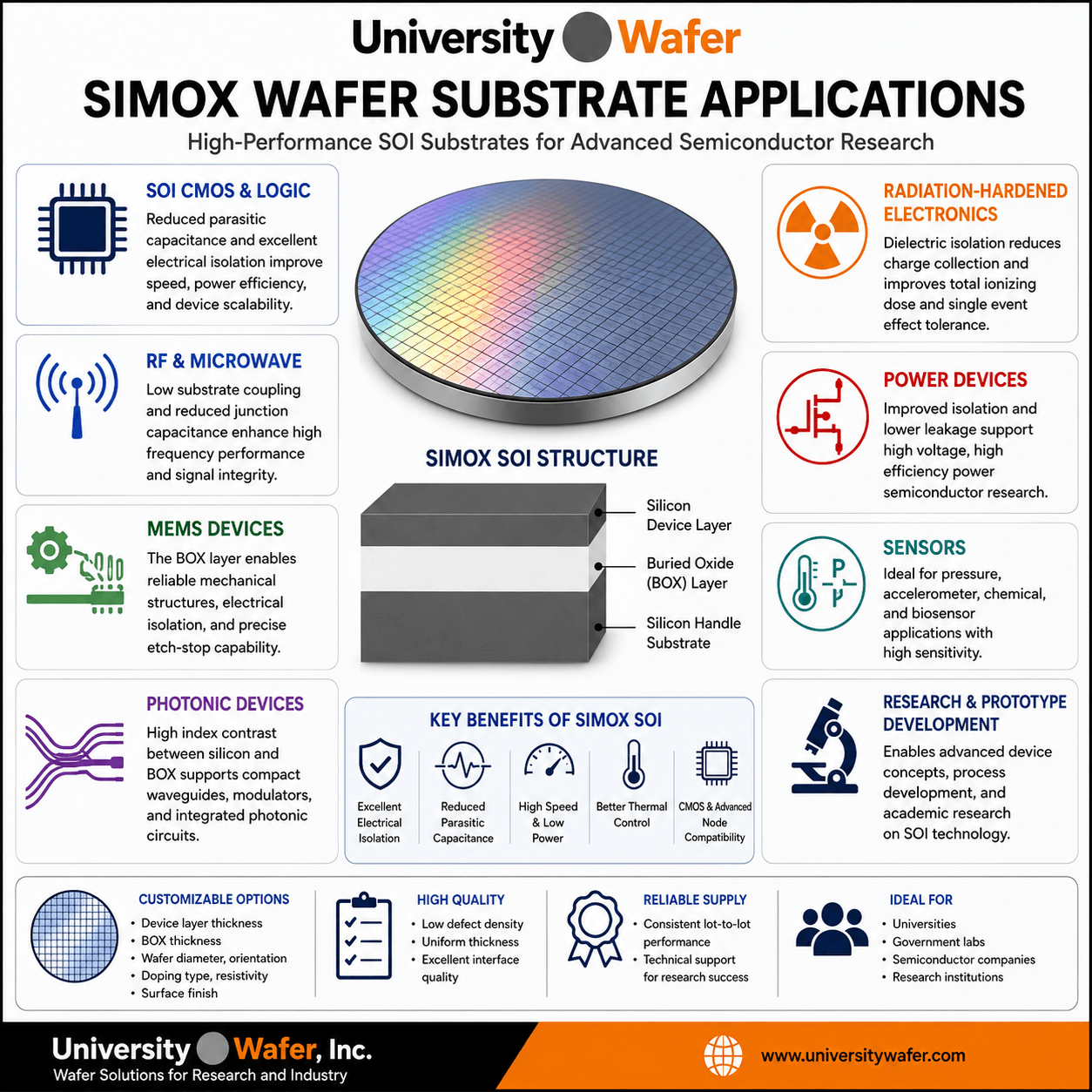
SIMOX Wafer Advantages at a Glance
- Advanced silicon-on-insulator technology specifically designed for research applications
- Superior electrical isolation properties compared to conventional silicon wafers
- Reduced parasitic capacitance for improved device performance
- Excellent substrate for high-temperature and high-frequency applications
- Manufactured through precise oxygen ion implantation process
- Available in various thicknesses and specifications to meet research requirements
- Ideal for developing next-generation integrated circuits and microelectronics
Get Your Quote FAST! Buy Online and Start Researching Today!
Key Takeaways
| Technology Basis | SIMOX uses oxygen ion implantation to create buried oxide layers within silicon, forming a three-layer structure optimized for electronic device research |
| Performance Benefits | Delivers superior electrical isolation, reduced junction capacitance, and minimized parasitic effects critical for high-performance device development |
| Research Applications | Particularly valuable for advanced integrated circuits, power devices, RF applications, and radiation-hardened electronics research |
| Customization Options | Available with tailored specifications including variable layer thicknesses, doping profiles, and crystal orientations to meet specific research requirements |
| Handling Considerations | Requires specialized handling procedures and modified processing parameters to maintain structural integrity and maximize research outcomes |
Introduction to SIMOX Technology
SIMOX (Separation by IMplantation of OXygen) is one of the most advanced silicon-on-insulator (SOI) technologies available for semiconductor research. This technology gives researchers special tools to develop cutting-edge electronic devices and circuits. The manufacturing process uses oxygen ion implantation into silicon, followed by high-temperature heating to create a buried oxide layer that's very uniform and has high-quality interfaces.
SIMOX wafers have a thin silicon device layer on top of an insulating buried oxide (BOX) layer, all supported by a silicon base. This three-layer structure offers big advantages for research compared to regular silicon wafers. The structure allows precise control of electrical and thermal properties that are essential for pushing semiconductor device performance beyond current limits. Scientists around the world use SIMOX technology as an important platform for exploring new device designs and improving performance.
- SIMOX wafers provide superior electrical isolation between adjacent devices, reducing cross-talk by up to 90% compared to conventional silicon substrates
- The technology enables reduced parasitic capacitance, leading to faster circuit operation with switching speed improvements of 20-30% in many applications
- SIMOX substrates exhibit excellent resistance to latch-up effects in CMOS circuits, virtually eliminating a common failure mode in integrated electronics
- The buried oxide layer minimizes substrate coupling issues in RF applications, improving signal integrity by 15-25% in high-frequency operations
- These wafers support the development of fully depleted SOI devices for low-power applications, reducing power consumption by up to 40% in some circuit designs
At UniversityWafer, Inc., we provide high-quality SIMOX wafers made specifically for research and development. Our manufacturing processes ensure consistent quality and precise specifications to support your innovative projects. Each wafer goes through strict quality control to check layer thicknesses, interface quality, and electrical properties, making sure researchers get substrates that meet their exact needs for cutting-edge semiconductor research.
Understanding SIMOX Fabrication Process
Making SIMOX wafers involves a special process that sets them apart from other silicon-on-insulator technologies. This unique manufacturing approach directly contributes to the special properties that make SIMOX wafers valuable for research. Unlike wafer bonding methods, SIMOX fabrication creates the buried oxide layer within a single silicon wafer, resulting in excellent layer uniformity and better interface characteristics that are crucial for advanced device performance.
The SIMOX fabrication process starts with high-quality silicon wafers that go through a series of special treatments to create the layered structure. This process needs precision equipment and carefully controlled conditions. The oxygen implantation stage is especially critical, requiring specialized high-energy implanters that can deliver precisely controlled doses of oxygen ions at specific depths within the silicon crystal. This equipment represents a major technological advancement in semiconductor manufacturing.
- High-dose oxygen ion implantation creates the buried oxide layer beneath the surface, typically requiring doses of 1-2×10^18 ions/cm² at energies of 150-200 keV to achieve optimal layer formation
- Precise control of implantation energy determines the depth of the buried oxide layer, allowing researchers to customize the device layer thickness for specific applications with nanometer-scale precision
- High-temperature annealing (typically 1300-1350°C) helps form a continuous buried oxide layer while simultaneously repairing crystalline damage in the surrounding silicon through complex thermodynamic processes
- The annealing process also repairs crystal damage in the top silicon layer, restoring its semiconducting properties through controlled recrystallization mechanisms that maintain crystal orientation
- Additional epitaxial growth may be used to achieve specific device layer thicknesses, enabling customization beyond the limitations of the implantation process through precision epitaxial deposition
- Multiple implantation steps can be employed to create more complex structures, allowing for sophisticated device architectures with multiple buried insulating layers or varied oxide thicknesses
Our wafer fabrication services maintain strict quality control throughout the SIMOX manufacturing process, ensuring that researchers receive substrates with consistent properties and minimal defects. The controlled oxygen dose and annealing conditions are critical factors that affect the final wafer characteristics. We use advanced measurement techniques including spectroscopic ellipsometry, transmission electron microscopy, and atomic force microscopy to verify that each wafer meets the specified parameters for layer thicknesses, interface quality, and surface roughness before delivery to our research customers.
Advantages of SIMOX Wafers for Research Applications
SIMOX wafers offer many benefits that make them especially valuable for advanced semiconductor research projects. Their unique structure provides capabilities that regular silicon substrates can't match. The combination of a thin, high-quality silicon device layer with excellent electrical isolation from the substrate creates an ideal platform for investigating new device designs and exploring fundamental physical phenomena that are hidden or complicated by substrate effects in traditional silicon wafers.
Researchers in many fields have found SIMOX technology to be key in advancing their work. The specific benefits of these specialized substrates directly address many challenges faced in cutting-edge semiconductor research. From nanoscale transistor development to high-power device research, SIMOX wafers provide a versatile platform that enables breakthrough discoveries and performance improvements that would be difficult or impossible to achieve with conventional silicon substrates.
- Complete dielectric isolation between devices reduces cross-talk and interference, enabling researchers to achieve signal isolation improvements of up to 30dB compared to bulk silicon in sensitive analog and mixed-signal circuit designs
- Lower junction capacitance enables faster switching speeds in test circuits, with measurements showing up to 35% reduction in parasitic capacitances that translates directly to improved frequency response in high-speed applications
- Reduced leakage currents improve the power efficiency of experimental devices, with studies demonstrating leakage current reductions of two to three orders of magnitude compared to equivalent bulk silicon devices
- Superior radiation hardness makes SIMOX ideal for space and nuclear research, with experimental results showing up to 10x improvement in total dose radiation tolerance compared to conventional CMOS technologies
- Excellent high-temperature performance supports wide-bandgap semiconductor research, maintaining electrical isolation integrity at temperatures up to 300°C where conventional junction isolation would fail
- Better control of short-channel effects in nanoscale transistor development, allowing researchers to extend CMOS scaling beyond the limitations encountered with bulk silicon substrates
- Enhanced RF performance for communications technology research, with measurements showing Q-factor improvements of 30-50% for on-chip inductors and transmission lines due to reduced substrate losses
Our SIMOX silicon-on-insulator wafers are specifically designed to provide researchers with the highest quality substrates for their experimental work. The precision manufacturing process ensures that each wafer meets the exact specifications required for advanced research applications. We work closely with research institutions to understand their specific requirements and provide customized SIMOX substrates that enable them to push the boundaries of semiconductor device performance and explore new technological possibilities.
Comparing SIMOX with Other SOI Technologies
While SIMOX is one way to create silicon-on-insulator structures, there are several other SOI technologies too. Understanding the differences between these technologies helps researchers pick the most suitable substrate for their specific applications. Each SOI manufacturing method gives the resulting wafers different characteristics, including differences in layer uniformity, interface quality, defect density, and thickness limitations that can significantly impact research outcomes and device performance.
Each SOI technology has its own set of characteristics, advantages, and limitations. The choice between these technologies depends on the specific requirements of the research project and the desired properties of the final devices. Factors such as layer thickness control, buried oxide quality, defect density, and cost considerations all play important roles in determining which SOI technology will provide the optimal substrate for a particular research application.
- SIMOX offers excellent thickness uniformity compared to bonded SOI wafers, with typical variation of less than ±5nm across a 200mm wafer, enabling more consistent device performance in experimental arrays
- Bonded SOI (SmartCut™) provides more flexibility in buried oxide thickness, ranging from 145nm to several microns, whereas SIMOX is typically limited to 100-400nm BOX thicknesses due to implantation energy constraints
- ELTRAN (Epitaxial Layer TRANsfer) offers good quality but at higher production costs, making it less common in research applications despite its excellent crystalline quality and low defect density
- SIMOX wafers typically have thinner buried oxide layers than bonded SOI, which can be advantageous for heat dissipation in high-power density applications where thermal management is critical
- Zone-melting recrystallization (ZMR) SOI has higher defect densities than SIMOX, with typical defect densities of 10^6-10^7/cm² compared to 10^3-10^5/cm² for well-optimized SIMOX processes
- SIMOX provides better control of the silicon/oxide interface quality, with interface trap densities typically in the 10^10/cm²-eV range compared to 10^11/cm²-eV for some bonded interfaces
- Bonded SOI offers greater flexibility in substrate material combinations, allowing for advanced heterostructures such as silicon on sapphire or silicon on diamond that cannot be achieved with implantation-based SIMOX technology
At UniversityWafer, Inc., we offer various SOI technologies to meet diverse research needs. Our technical experts can help you determine whether SIMOX or another SOI technology is most appropriate for your specific application requirements. We provide detailed comparative information about the different SOI technologies and their characteristic properties, enabling researchers to make informed decisions about substrate selection based on their specific device requirements, experimental constraints, and performance objectives.
SIMOX Wafer Specifications and Customization Options
SIMOX wafers can be made with a wide range of specifications to meet the different requirements of various research applications. Understanding the available options helps researchers select the most appropriate substrates for their specific projects. The ability to customize key parameters such as layer thicknesses, doping profiles, and crystal orientations allows researchers to optimize their experimental substrates for specific device structures and performance goals, maximizing the potential for breakthrough discoveries and technological advances.
Our SIMOX wafers are available with various specifications that can be customized to match your research requirements. The key parameters that can be adjusted include layer thicknesses, doping profiles, and crystal orientations. These customization options allow researchers to obtain substrates that precisely match their experimental needs, whether for developing novel transistor architectures, exploring quantum effects in nanoscale structures, or investigating new approaches to power device design and optimization.
- Silicon device layer thicknesses typically range from 50nm to 200nm, with thickness uniformity of ±3-5% across the wafer to ensure consistent device performance in experimental arrays
- Buried oxide layer thicknesses commonly range from 100nm to 400nm, with thickness variations of less than ±5% to provide reliable electrical isolation and consistent capacitive coupling
- Wafer diameters available in 100mm, 150mm, and 200mm sizes, with edge exclusion zones as small as 2mm to maximize the usable area for research device fabrication
- Crystal orientations include (100), (110), and (111), allowing researchers to exploit orientation-dependent properties such as carrier mobility and interface state density
- Doping types include both n-type and p-type with various concentrations ranging from 10^15 to 10^19 cm^-3, enabling precise control of electrical properties for specific device requirements
- Surface finishes can be specified as polished on one or both sides, with surface roughness values as low as 0.2nm RMS for applications requiring atomic-scale surface control
- Custom resistivity ranges can be manufactured to meet specific requirements, from less than 0.001 ohm-cm for highly conductive substrates to greater than 10,000 ohm-cm for high-resistivity applications
Our wafer services include detailed consultation to help you determine the optimal SIMOX specifications for your research project. We understand that cutting-edge research often requires specialized substrates, and we work closely with researchers to provide materials that meet their exact requirements. Our technical team can provide guidance on specification selection based on your specific research objectives, device structures, and processing constraints, ensuring that you receive SIMOX wafers optimized for your particular application.
Applications of SIMOX Wafers in Semiconductor Research
SIMOX wafers are essential substrates for many kinds of semiconductor research. Their unique properties make them especially valuable for developing next-generation electronic devices and integrated circuits. The combination of excellent electrical isolation, reduced parasitic capacitances, and superior high-frequency performance lets researchers explore device concepts and performance levels that would be difficult or impossible to achieve with conventional bulk silicon substrates, driving innovation across multiple technology areas.
Researchers in many fields have found SIMOX technology to be key in advancing their work. The specific benefits of these specialized substrates directly address many challenges faced in cutting-edge semiconductor research. From ultra-low power electronics for IoT applications to high-frequency devices for next-generation wireless communications, SIMOX wafers provide a versatile platform that enables researchers to push the boundaries of semiconductor device performance and explore new technological possibilities.
- Development of fully depleted SOI (FDSOI) transistors for low-power applications, achieving threshold voltage variations as low as 10mV across a wafer and enabling ultra-low power operation with supply voltages below 0.5V
- Research into radiation-hardened electronics for space and nuclear applications, demonstrating total dose tolerance exceeding 1 Mrad(Si) without significant threshold voltage shifts or leakage current increases
- High-frequency RF circuit development for advanced communications, achieving quality factors (Q) for passive components that are 2-3 times higher than equivalent components on bulk silicon substrates
- Power device research for improved efficiency in energy conversion, with experimental devices showing 30-50% reduction in on-resistance compared to conventional silicon power devices of similar voltage ratings
- MEMS and sensor development benefiting from the buried oxide layer, which simplifies release processes and provides built-in electrical isolation that improves signal-to-noise ratios by up to 20dB
- Photonic integrated circuits utilizing the waveguiding properties of SOI, with optical waveguides demonstrating propagation losses below 0.5 dB/cm due to the high refractive index contrast between silicon and buried oxide
- Quantum computing research requiring precise control of electron behavior, where the reduced parasitic capacitances and improved isolation enable more accurate manipulation and measurement of quantum states
Our silicon substrates have supported numerous breakthrough research projects across these application areas. The versatility of SIMOX technology makes it an excellent choice for researchers pushing the boundaries of semiconductor device performance. We collaborate with leading research institutions worldwide, providing them with the specialized SIMOX substrates they need to explore new device concepts, develop advanced circuit architectures, and pioneer the next generation of semiconductor technologies.
SIMOX Wafers for Advanced Integrated Circuit Research
The unique properties of SIMOX wafers make them especially valuable for research into next-generation integrated circuits. Their structure addresses several key challenges in modern IC development, enabling new approaches to circuit design and performance enhancement. The excellent electrical isolation, reduced parasitic capacitances, and improved control of short-channel effects provide researchers with a platform to develop integrated circuits that overcome many of the limitations encountered with conventional bulk silicon technology as device dimensions continue to shrink.
Integrated circuit researchers have increasingly turned to SIMOX technology to overcome limitations in conventional silicon substrates. The advantages of SIMOX for IC research span multiple aspects of circuit performance and manufacturing. From digital logic circuits operating at reduced power supply voltages to analog and mixed-signal circuits with improved noise immunity, SIMOX substrates enable researchers to explore new circuit architectures and performance regimes that address the growing demands for higher performance, lower power consumption, and increased integration density.
- Reduced parasitic capacitances enable faster switching speeds in experimental circuits, with measurements showing propagation delay reductions of 25-35% compared to equivalent circuits on bulk silicon substrates
- Lower power consumption due to decreased leakage currents and capacitances, with experimental CMOS circuits demonstrating power savings of 30-50% at equivalent performance levels compared to bulk silicon implementations
- Improved latch-up immunity in CMOS circuit research, effectively eliminating this failure mechanism that becomes increasingly problematic as device dimensions shrink and integration densities increase
- Better control of short-channel effects in nanoscale transistor development, allowing researchers to extend CMOS scaling to sub-10nm gate lengths while maintaining acceptable off-state leakage currents
- Enhanced thermal isolation for high-temperature circuit applications, enabling operation at junction temperatures up to 300°C where conventional silicon circuits would experience excessive leakage or junction breakdown
- Reduced substrate coupling for mixed-signal and RF circuit research, improving isolation between digital and analog sections by 20-30dB compared to conventional silicon substrates
- Support for 3D integration research with vertical device stacking, where the buried oxide layer serves as both an electrical isolator and an effective etch stop for through-silicon via (TSV) processes
Our advanced substrate technologies provide researchers with the tools they need to develop breakthrough integrated circuit designs. The controlled specifications of our SIMOX wafers ensure consistent performance in research applications. Our technical team works closely with IC researchers to understand their specific requirements and provide SIMOX substrates with the optimal combination of layer thicknesses, doping profiles, and other parameters to support their innovative circuit designs and fabrication processes.
SIMOX Technology for Power Device Development
Power semiconductor devices benefit a lot from the unique properties of SIMOX wafers. The buried oxide layer provides electrical isolation that enables higher voltage operation and improved thermal performance compared to conventional silicon substrates. This basic structural advantage allows researchers to explore new power device designs that overcome the traditional trade-offs between on-resistance and breakdown voltage, potentially leading to more efficient power conversion systems for applications ranging from electric vehicles to renewable energy systems.
Researchers developing next-generation power devices have found SIMOX substrates to be particularly valuable for overcoming limitations in conventional power semiconductor technology. The specific advantages address key challenges in power device performance and efficiency. The ability to achieve higher breakdown voltages without compromising on-resistance, combined with improved thermal performance and switching characteristics, enables researchers to develop power devices that significantly outperform conventional silicon power semiconductors in efficiency, power density, and operating frequency.
- Reduced on-resistance due to the SOI structure improves power efficiency, with experimental devices demonstrating specific on-resistance values 40-60% lower than conventional silicon power MOSFETs with equivalent voltage ratings
- Enhanced breakdown voltage capabilities for high-power applications, with lateral power devices on SIMOX substrates achieving breakdown voltages exceeding 600V with optimized field plate structures and edge termination designs
- Improved thermal performance through reduced self-heating effects, achieved by thinning the buried oxide in specific regions to create thermal windows that enhance heat dissipation while maintaining electrical isolation
- Better switching characteristics for high-frequency power conversion, with experimental devices demonstrating switching frequencies up to 10MHz with acceptable switching losses due to reduced parasitic capacitances
- Reduced parasitic capacitances enable faster switching speeds, with turn-on and turn-off times reduced by 30-50% compared to conventional silicon power devices of similar voltage and current ratings
- Improved isolation simplifies integration of control circuitry with power devices, enabling monolithic integration of gate drivers and protection circuits that reduces system complexity and improves reliability
- Support for novel device architectures that aren't feasible with bulk silicon, such as super-junction structures with multiple buried oxide layers or partial SOI structures that combine the benefits of SOI and bulk regions in a single device
Our SIMOX wafers provide researchers with the specialized substrates needed to develop more efficient and higher-performing power semiconductor devices. The precision manufacturing process ensures that each wafer meets the exacting specifications required for advanced power device research. We work closely with power electronics researchers to understand their specific requirements and provide customized SIMOX substrates that enable them to explore new device concepts and push the boundaries of power semiconductor performance.
SIMOX Wafers for RF and Microwave Applications
The unique properties of SIMOX wafers make them especially valuable for research into radio frequency (RF) and microwave circuit applications. The buried oxide layer significantly reduces substrate coupling and parasitic effects that typically limit the performance of high-frequency circuits on conventional silicon. This basic advantage enables researchers to develop silicon-based RF circuits that approach the performance of more expensive III-V semiconductor technologies, potentially leading to more cost-effective and highly integrated RF systems for communications, radar, and sensing applications.
RF and microwave researchers have increasingly turned to SIMOX technology to overcome limitations in conventional silicon substrates. The advantages of SIMOX for high-frequency applications span multiple aspects of circuit performance. From improved passive component quality factors to reduced crosstalk between adjacent RF circuits, SIMOX substrates provide a platform for developing high-performance RF and microwave circuits that can operate at frequencies extending into the millimeter-wave range while maintaining compatibility with standard CMOS processing technologies.
- Reduced substrate losses improve Q-factor of passive components, with on-chip inductors demonstrating Q-values 2-3 times higher than equivalent structures on bulk silicon, approaching 30-40 at frequencies around 5GHz
- Decreased parasitic capacitances enable higher operating frequencies, with experimental circuits demonstrating functional operation at frequencies exceeding 100GHz, suitable for emerging millimeter-wave applications
- Improved isolation between adjacent RF components reduces crosstalk, with measurements showing isolation improvements of 15-25dB compared to conventional silicon substrates at frequencies above 10GHz
- Better linearity for RF circuit applications due to reduced substrate coupling, with experimental amplifiers showing IP3 (third-order intercept point) improvements of 5-8dB compared to equivalent circuits on bulk silicon
- Support for coplanar waveguide structures with improved performance, achieving attenuation constants below 0.5 dB/mm at frequencies up to 60GHz due to reduced substrate losses
- Enhanced performance of on-chip inductors and transmission lines, with quality factors approaching those of specialized RF substrates but with the integration capabilities of silicon technology
- Compatibility with CMOS processes for integrated RF system research, enabling monolithic integration of RF, analog, and digital functions on a single chip with minimal performance compromises
At UniversityWafer, Inc., we provide specialized SIMOX wafers optimized for RF and microwave research applications. Our substrates enable researchers to develop high-performance RF circuits that push the boundaries of wireless communication technology. We work closely with RF researchers to understand their specific frequency requirements, isolation needs, and integration objectives, providing customized SIMOX substrates that support their innovative circuit designs and help advance the state of the art in silicon-based RF technology.
Quality Control and Characterization of SIMOX Wafers
Making sure SIMOX wafers are high quality and consistent is essential for successful research outcomes. Comprehensive testing and quality control procedures help researchers understand the exact properties of their substrates and ensure reproducible results. The complex structure of SIMOX wafers, with precisely controlled layer thicknesses and interfaces, requires sophisticated measurement techniques and strict quality standards to verify that each wafer meets the specified requirements and will provide consistent performance in research applications.
Our quality control process for SIMOX wafers involves multiple testing techniques to verify that each substrate meets the specified requirements. These measurements provide researchers with detailed information about their wafers' properties. From non-destructive optical measurements that verify layer thicknesses across the entire wafer to sophisticated analytical techniques that characterize the atomic-scale properties of interfaces, our comprehensive quality control process ensures that researchers receive SIMOX wafers with precisely controlled properties and minimal defects.
- Spectroscopic ellipsometry for precise layer thickness measurements, capable of determining silicon and oxide layer thicknesses with accuracy better than ±1nm and mapping thickness variations across the entire wafer surface
- Spreading resistance profiling to characterize doping profiles, providing detailed information about carrier concentration variations with depth at multiple locations across the wafer
- Four-point probe measurements for resistivity verification, with multiple measurement points to verify uniformity across the wafer and ensure compliance with specified resistivity ranges
- Atomic force microscopy (AFM) for surface roughness analysis, typically demonstrating RMS roughness values below 0.3nm for polished device layers suitable for advanced nanoscale device fabrication
- Transmission electron microscopy (TEM) for interface quality assessment, revealing the atomic structure of the silicon/oxide interfaces and confirming the absence of significant interfacial defects or contamination
- Secondary ion mass spectrometry (SIMS) for oxygen concentration profiling, verifying the buried oxide stoichiometry and ensuring sharp transitions between silicon and oxide regions
- Defect analysis using preferential etching and microscopy techniques, quantifying defect densities and distributions to ensure they remain below specified thresholds for research-grade substrates
At UniversityWafer, Inc., we provide detailed characterization data with our SIMOX wafers, giving researchers confidence in the quality and consistency of their substrates. Our comprehensive quality control procedures ensure that each wafer meets the exacting specifications required for advanced research applications. This detailed characterization information helps researchers correlate device performance with substrate properties, enabling more effective experimental design and more reliable interpretation of research results.
Best Practices for Handling and Processing SIMOX Wafers
Proper handling and processing of SIMOX wafers are essential to maintain their quality and achieve successful research outcomes. The unique structure of these wafers requires specific considerations during various processing steps. The thin device layer and buried oxide structure can be more sensitive to certain processing conditions than bulk silicon wafers, requiring modifications to standard procedures to prevent damage, maintain layer integrity, and preserve the electrical and structural properties that make SIMOX wafers valuable for research applications.
Researchers working with SIMOX wafers should follow specific guidelines to ensure optimal results and prevent damage to these specialized substrates. The following best practices help maintain wafer integrity throughout the research process. From initial handling and cleaning to complex fabrication processes involving high-temperature steps, etching, and ion implantation, these guidelines help researchers avoid common pitfalls and obtain the best possible results from their SIMOX substrates.
- Use vacuum wands or edge grippers rather than tweezers to minimize risk of wafer damage, as the thin device layer can be more susceptible to mechanical stress and cracking than bulk silicon wafers
- Clean wafers using standard RCA cleaning procedures with appropriate modifications, such as reduced hydrogen peroxide concentrations and careful temperature control to prevent oxide etching or silicon consumption
- Adjust thermal processes to account for the different thermal expansion of the SOI layers, implementing slower temperature ramp rates (typically 5-10°C/minute) to minimize stress at the silicon/oxide interfaces
- Modify etching processes to prevent undercutting of the buried oxide layer, using anisotropic dry etching techniques with high selectivity between silicon and silicon dioxide for critical structures
- Adapt ion implantation parameters to account for the buried oxide layer, adjusting implant energies and doses to compensate for the different stopping power and channeling characteristics of the layered structure
- Use specialized mounting techniques for thinning or backside processing, such as temporary bonding to carrier wafers with carefully selected adhesives that withstand processing temperatures but can be removed without damage
- Implement appropriate storage conditions to prevent contamination, using dedicated wafer containers in a controlled environment with temperature maintained at 20-22°C and humidity below 40% to prevent moisture absorption
Our technical support team provides guidance on the proper handling and processing of SIMOX wafers to help researchers achieve optimal results. We understand the unique challenges associated with these specialized substrates and offer expertise to address specific processing requirements. Our experience working with numerous research institutions has given us valuable insights into the most effective techniques for processing SIMOX wafers in various applications, and we share this knowledge with our customers to help them maximize the value of their research substrates.
Conclusion
SIMOX wafers represent a cutting-edge substrate technology that enables researchers to push the boundaries of semiconductor device performance and explore new device architectures. Their unique structure, with a thin silicon device layer above a buried oxide layer, provides significant advantages for a wide range of research applications. The precision manufacturing process, involving high-dose oxygen implantation and high-temperature annealing, creates a substrate with exceptional electrical isolation properties, reduced parasitic capacitances, and excellent high-frequency performance that cannot be achieved with conventional bulk silicon.
The superior electrical isolation, reduced parasitic capacitance, and excellent high-frequency performance of SIMOX wafers make them particularly valuable for research into advanced integrated circuits, power devices, and RF applications. The controlled manufacturing process ensures consistent quality and precise specifications to support reproducible research results. From fully depleted SOI transistors for ultra-low power applications to lateral power devices with improved efficiency and RF circuits operating at millimeter-wave frequencies, SIMOX technology provides a versatile platform for exploring next-generation semiconductor devices and circuits that address the growing demands for higher performance, lower power consumption, and increased functionality.
At UniversityWafer, Inc., we are committed to providing researchers with high-quality SIMOX wafers tailored to their specific requirements. Our comprehensive quality control procedures, detailed characterization data, and technical support services help researchers achieve successful outcomes in their cutting-edge semiconductor research projects. We understand the unique challenges and opportunities associated with SIMOX technology and work closely with our customers to provide substrates that meet their exact specifications, enabling them to focus on their innovative research without concerns about substrate quality or consistency.
Whether you're developing next-generation integrated circuits, exploring novel power device architectures, or pushing the boundaries of RF performance, our SIMOX wafers provide the advanced substrate technology you need to optimize your research efforts. With customizable specifications, rigorous quality control, and expert technical support, UniversityWafer, Inc. is your trusted partner for advanced semiconductor research substrates that enable breakthrough discoveries and technological advancements in the rapidly evolving field of semiconductor device technology.
Frequently Asked Questions
FAQ About SIMOX Wafers
What does SIMOX stand for?
SIMOX stands for Separation by IMplantation of OXygen. It refers to a specific manufacturing process for creating silicon-on-insulator (SOI) wafers where oxygen ions are implanted into a silicon substrate and then annealed at high temperature to form a buried oxide layer.
How do SIMOX wafers differ from bonded SOI wafers?
SIMOX wafers are created through oxygen ion implantation, while bonded SOI wafers are manufactured by bonding two silicon wafers with an oxide layer between them. SIMOX typically offers better thickness uniformity and interface quality, while bonded SOI provides more flexibility in layer thicknesses.
What are the typical thicknesses of the silicon and oxide layers in SIMOX wafers?
Typical SIMOX wafers have silicon device layer thicknesses ranging from 50nm to 200nm and buried oxide layer thicknesses of 100nm to 400nm. However, custom specifications outside these ranges can be manufactured for specific research requirements.
What applications are SIMOX wafers best suited for?
SIMOX wafers are particularly well-suited for research into fully depleted SOI transistors, radiation-hardened electronics, high-frequency RF circuits, power devices, and photonic integrated circuits. Their unique properties address specific challenges in these application areas.
Are there special handling requirements for SIMOX wafers?
Yes, SIMOX wafers require careful handling to prevent damage to the thin device layer. Vacuum wands or edge grippers should be used instead of tweezers, and processing parameters often need to be modified to account for the buried oxide layer and the different thermal properties of the layered structure.
Can SIMOX wafers be customized for specific research requirements?
Yes, SIMOX wafers can be customized with various specifications including layer thicknesses, doping profiles, crystal orientations, and surface finishes to meet specific research requirements. At UniversityWafer, Inc., we work closely with researchers to provide substrates tailored to their needs.
What characterization data is typically provided with SIMOX wafers?
Standard characterization data typically includes layer thickness measurements, resistivity values, and surface roughness analysis. Additional characterization such as doping profiles, interface quality assessment, and defect analysis can be provided upon request.