
What Is Soda Lime Glass?
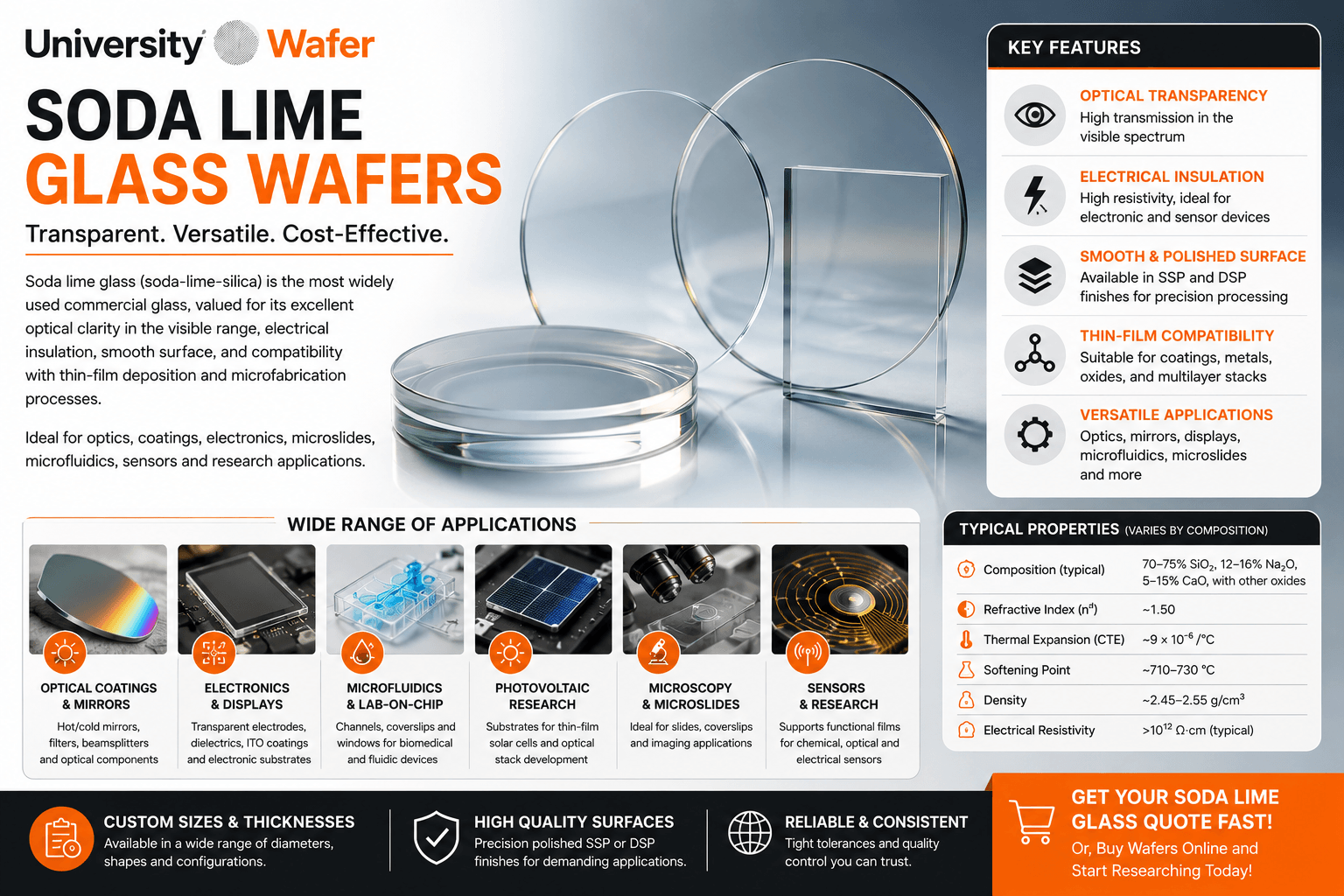
Soda lime glass, more precisely soda-lime-silica glass, is the most widely produced family of commercial glass. It is composed primarily of silica (SiO2), with sodium oxide (Na2O) and calcium oxide (CaO) as major modifying components. Typical formulations may also contain magnesium oxide, aluminum oxide, and small quantities of other constituents.
The exact chemical composition varies by manufacturer and glass grade, so properties such as optical transmission, refractive index, thermal expansion, chemical durability, and electrical behavior should be confirmed for the specific material when they are critical to an experiment or device.
Soda lime glass is attractive for research and fabrication because it is economical, electrically insulating, optically transparent across much of the visible spectrum, and compatible with many thin-film and microfabrication processes.
Soda Lime Glass Wafers and Substrates
Soda lime glass wafers provide a cost-effective substrate for applications that do not require the very low thermal expansion, ultraviolet transmission, or high-temperature capability of more specialized glasses.
Depending on the application, soda lime substrates can be supplied as circular wafers, square pieces, windows, slides, or other geometries. UniversityWafer offers soda lime substrates in multiple sizes and thicknesses for laboratory and device research.
Researchers comparing different glass families can explore glass wafers and substrates for additional materials used in semiconductor, optical, MEMS, and microfabrication applications.
Composition of Soda Lime Glass
The glass network is formed primarily from SiO4 structural units. Sodium-containing compounds act as network modifiers that lower the temperature required to melt and process silica-based glass, while calcium-containing compounds help improve chemical durability.
A representative soda-lime-silica composition is approximately 70–75 wt% SiO2, 12–16 wt% Na2O, and roughly 5–15 wt% CaO, with MgO, Al2O3, and other constituents varying with the formulation.
These ranges are representative rather than universal. Precision applications should use the composition and property data for the specific glass grade being supplied.
Optical Properties of Soda Lime Glass
Soda lime glass substrates transmit a substantial portion of visible light, which makes them useful for optical windows, microscopy, imaging, displays, coated optics, and general laboratory applications.
Optical transmission depends on glass composition, thickness, iron content, surface finish, coatings, and wavelength. Standard soda lime glass should therefore not be assumed to have the broad ultraviolet-to-infrared transmission of fused silica.
The refractive index of common soda-lime-silica glasses is typically around 1.5 in the visible region, although the exact value varies with composition and wavelength.
Soda Lime Glass for Optical Windows
Soda lime glass windows can provide an economical transparent barrier for instruments, test fixtures, displays, imaging systems, and laboratory equipment operating primarily in the visible spectral region.
Surface quality, flatness, parallelism, thickness, and edge condition should be selected according to the optical requirements. Applications involving precision interferometry, demanding ultraviolet transmission, or extreme thermal cycling may require a different glass material.
Soda Lime Glass for Hot and Cold Mirrors
Soda lime glass can serve as the substrate for wavelength-selective optical coatings used to fabricate hot mirrors, cold mirrors, and other interference-filter structures.
Importantly, the soda lime glass itself does not inherently function as a hot or cold mirror. The wavelength-selective reflection and transmission are produced primarily by engineered multilayer thin-film coatings deposited on the glass.
A hot-mirror coating can be designed to transmit much of the visible spectrum while reflecting selected infrared wavelengths. A cold-mirror coating can instead be designed to reflect selected visible wavelengths while transmitting a significant portion of the infrared, depending on the optical design.
Soda Lime Glass for Thin-Film Deposition
A smooth glass substrate can support deposited metals, transparent conductive oxides, dielectric coatings, optical multilayers, and other research films.
Deposition methods may include physical vapor deposition, sputtering, evaporation, or compatible chemical deposition techniques, depending on the material and required process temperature.
When depositing thin films on soda lime glass, researchers should consider surface cleanliness, adhesion, substrate temperature, sodium content, thermal-expansion mismatch, and film stress.
Transparent Conductive Coatings on Soda Lime Glass
Soda lime substrates can support transparent conductive oxide (TCO) coatings when an electrically conductive but optically transparent surface is required.
One commonly used TCO is indium tin oxide (ITO) , which can be deposited on glass for applications involving electrodes, displays, sensors, optoelectronics, and other transparent electronic structures.
The final sheet resistance and optical transmission depend on the ITO thickness, composition, deposition conditions, post-deposition treatment, and substrate characteristics.
Soda Lime Glass for Microfabrication
Soda lime glass wafers for microfabrication can provide a transparent and electrically insulating platform for lithography, thin-film patterning, microfluidics, sensors, and experimental device fabrication.
UniversityWafer has supplied soda lime substrates for applications including photolithography and microfabrication molds. Depending on the process, researchers may require controlled thickness, double-side polishing, low surface contamination, or specific wafer dimensions.
Surface preparation is particularly important before lithography or thin-film deposition because particles, organic residues, and other contamination can reduce adhesion or introduce defects.
Soda Lime Glass for Microfluidic Devices
Soda lime glass microfluidic substrates can be used to fabricate channels, covers, windows, and other components for lab-on-chip and biomedical research devices.
Glass offers several useful characteristics for microfluidics, including visible transparency, electrical insulation, relatively smooth surfaces, and compatibility with many laboratory environments. Its transparency can be particularly useful when channels must be observed using optical microscopy.
Chemical compatibility should be evaluated for the specific fluid, temperature, exposure duration, and glass composition used in the experiment.
Electrical Insulation Properties
Soda lime glass is generally an electrical insulator, which can make it useful as a substrate beneath patterned metal traces, electrodes, sensors, and other electronic structures.
Electrical resistivity is not a universal constant and changes with temperature, composition, moisture, frequency, and glass condition. For demanding dielectric applications, electrical properties should therefore be specified for the particular glass grade and operating environment.
Soda Lime Glass for Sensors
The combination of optical transparency and electrical insulation makes soda lime glass substrates useful for selected sensor platforms. Metal electrodes, conductive oxides, dielectric films, or functional sensing layers can be deposited and patterned on the surface.
Applications can include optical, electrical, chemical, microfluidic, and experimental sensor structures, provided that the substrate's thermal and chemical limitations are compatible with fabrication and operation.
Thermal Properties of Soda Lime Glass
Soda lime glass has a substantially higher coefficient of thermal expansion than fused silica. A representative value for flat soda-lime-silica glass is approximately 9 × 10⁻⁶ K-1, although the exact value varies with composition.
This relatively high thermal expansion means that rapid temperature changes or strong temperature gradients can generate thermal stress. Soda lime glass should therefore not be treated as a high-thermal-shock substrate.
Applications involving large temperature excursions, high processing temperatures, or severe thermal shock may be better suited to fused silica substrates or another glass engineered for lower thermal expansion.
Soda Lime Glass vs. Fused Silica
Soda lime glass and fused silica serve different application requirements. Soda lime glass is generally the more economical choice for visible optical windows, laboratory substrates, microfabrication, and applications with moderate thermal requirements.
Fused silica consists primarily of SiO2 and offers much lower thermal expansion, superior thermal-shock resistance, and broader useful optical transmission into the ultraviolet compared with typical soda lime glass.
Researchers should select between these materials based on optical wavelength, thermal budget, chemical environment, dimensional requirements, and cost rather than assuming one glass is universally superior.
Soda Lime Glass vs. Borosilicate Glass
Borosilicate glass generally has a lower coefficient of thermal expansion than soda lime glass, giving it improved resistance to thermal shock and dimensional change during temperature cycling.
Soda lime glass can still be advantageous when cost, visible transparency, electrical insulation, and availability are more important than high-temperature or thermal-shock performance.
Compare additional options on our glass wafer materials page for semiconductor, MEMS, optical, and laboratory applications.
Surface Finish and Polishing
Polished soda lime glass wafers can be selected for applications requiring smooth surfaces for optical coatings, photolithography, microscopy, bonding, or thin-film deposition.
Both single-side polished (SSP) and double-side polished (DSP) configurations may be appropriate depending on the application. DSP substrates are particularly useful when optical access, surface quality, or processing is required on both sides.
Surface roughness, scratches, particles, flatness, and edge condition should be specified when these characteristics can influence device fabrication or optical performance.
Selecting a Soda Lime Glass Substrate
The correct soda lime glass wafer specification depends on the intended experiment, fabrication process, and operating environment. Useful parameters to specify include:
- Wafer diameter or substrate dimensions
- Glass thickness and thickness tolerance
- Single-side or double-side polish
- Surface quality and roughness
- Flatness and parallelism
- Optical wavelength range
- Maximum processing temperature
- Required thin-film coatings
- Electrical insulation requirements
- Intended chemical environment
- Required shape, dicing, or custom dimensions
Providing the intended application helps determine whether soda lime glass offers the appropriate combination of optical, electrical, thermal, and mechanical properties or whether another glass substrate would be better suited to the project.
Get Your Soda Lime Glass Quote FAST!
Or,
Buy Wafers Online
and Start Researching Today!
Soda Lime Glass for Optical and Electronic Applications
Soda lime glass substrates provide an economical, transparent, and electrically insulating platform for a wide range of optical, electronic, sensing, and thin-film research applications. Because the material is readily available in flat, smooth sheets, it can be processed into wafers, windows, slides, and custom substrate geometries.
The suitability of soda lime glass depends on the application's optical wavelength, thermal budget, chemical environment, dimensional requirements, surface finish, and deposited-film stack. It should not automatically be substituted for fused silica or borosilicate glass in applications requiring very low thermal expansion or demanding high-temperature performance.
Soda Lime Glass for Optical Coatings
Soda lime optical glass substrates can support dielectric and metallic coatings used to modify reflection, transmission, absorption, or electrical conductivity.
Depending on the application, coatings can be deposited by techniques such as sputtering, evaporation, or other compatible physical and chemical deposition methods. The substrate itself primarily provides mechanical support, while the deposited film or multilayer stack determines much of the final optical functionality.
Before coating, surface cleanliness and roughness are important because particles, residues, scratches, and surface defects can affect adhesion, scattering, coating uniformity, and optical performance.
Hot Mirrors and Cold Mirrors on Soda Lime Glass
Soda lime glass can serve as the supporting substrate for hot mirrors and cold mirrors. These optical components use wavelength-selective thin-film stacks rather than relying on the uncoated glass to produce their spectral behavior.
A hot-mirror coating is commonly designed to transmit much of the visible spectrum while reflecting selected infrared wavelengths. A cold-mirror design can instead reflect a selected visible band while transmitting a significant portion of longer-wavelength infrared radiation. Exact behavior depends on the multilayer coating design and angle of incidence.
This distinction is important: soda lime glass itself is not inherently a hot or cold mirror. The spectral selectivity comes primarily from the engineered optical coating.
Soda Lime Glass for Transparent Electrodes
Electrically insulating glass can provide a useful foundation for transparent conductive electrodes. Conductive films can be deposited and patterned on the glass while the underlying substrate remains electrically insulating.
A common example is indium tin oxide (ITO) coated glass . ITO can combine visible transparency with electrical conductivity and is widely used in transparent-electrode research.
Optical transmission and sheet resistance depend on film thickness, composition, deposition conditions, annealing history, and substrate properties, so these parameters should be specified for the intended device.
Soda Lime Glass for Displays and Optoelectronics
Glass substrates for displays and optoelectronics can support patterned conductors, transparent conductive oxides, dielectric layers, and other functional films. Soda lime glass may be appropriate for research structures where its cost, visible transparency, and processing characteristics meet the device requirements.
More demanding display fabrication may require specialized glass compositions with tighter dimensional stability, lower alkali content, or different thermal characteristics. Substrate selection should therefore be based on the actual fabrication temperature and device architecture.
Soda Lime Glass for Photovoltaic Research
Soda-lime glass is widely associated with thin-film photovoltaic structures, particularly as a transparent supporting substrate or superstrate. Functional semiconductor, conductive, and optical layers are deposited on the glass to create the active photovoltaic stack.
In some thin-film photovoltaic material systems, sodium originating from soda-lime glass can diffuse into deposited layers and influence material growth and device properties. Whether this effect is beneficial, undesirable, or must be controlled depends on the absorber material, barrier layers, and fabrication process.
For semiconductor photovoltaic research, explore semiconductor substrates for solar-cell research .
Alkali Content and Sodium Diffusion
One important processing consideration for soda-lime-silica glass is its sodium content. Sodium ions can become mobile under certain combinations of temperature, electric field, moisture, and processing conditions.
Sodium diffusion may be undesirable in some semiconductor and electronic structures because mobile alkali ions can affect electrical behavior or contaminate sensitive layers. In these applications, an appropriate diffusion-barrier layer may be required between the soda lime substrate and the device stack.
This is one reason specialized alkali-free or low-alkali glasses are sometimes preferred for demanding electronic applications.
Soda Lime Glass for Sensors
The combination of visible transparency and electrical insulation makes soda lime glass useful for selected sensor platforms. Electrodes, optical films, conductive oxides, and functional sensing layers can be patterned on the surface.
Transparent substrates can be particularly useful when a sensor requires optical interrogation through the back of the device or simultaneous microscopic observation.
Sensor designs should account for substrate thickness, dielectric behavior, thermal expansion, surface condition, and compatibility with the sensing environment.
Soda Lime Glass for Microfluidics
Soda lime glass microfluidic substrates can be used for channels, covers, observation windows, electrodes, and other components in lab-on-chip research.
Optical transparency allows researchers to observe fluid movement and particles using microscopy, while the electrically insulating substrate can support patterned electrodes for selected electrokinetic or sensing applications.
Chemical compatibility must be evaluated for the actual fluid system. Soda lime glass is chemically durable for many common uses, but it is not resistant to every chemical environment.
Chemical Resistance of Soda Lime Glass
Soda lime glass has useful chemical durability for many laboratory and commercial applications, but its resistance is not universal. Surface attack and ion exchange can occur under sufficiently aggressive chemical conditions.
In particular, hydrofluoric acid (HF) attacks silica-containing glass and is commonly used in processes designed to etch glass. Strong alkaline solutions can also attack silicate glass, particularly with increased temperature or prolonged exposure.
Chemical compatibility should therefore be evaluated according to chemical concentration, temperature, exposure time, and glass composition.
Etching Soda Lime Glass
Controlled glass etching can be used to create recessed features, channels, cavities, or other structures for microfabrication and microfluidic research.
HF-containing solutions can etch silica-based glass, but etch rate, surface morphology, masking requirements, and feature quality depend on the glass composition and process conditions.
Dry-etching approaches may also be used for specialized structures when compatible equipment and chemistries are available.
Photolithography on Soda Lime Glass
Soda lime glass wafers for photolithography can provide a transparent substrate for patterned metals, conductive oxides, dielectric films, microfluidic structures, and experimental devices.
Successful lithography requires attention to surface cleanliness, photoresist adhesion, substrate flatness, exposure conditions, and compatibility with subsequent development and etching processes.
Transparent substrates can require adjustments to lithographic processing compared with opaque silicon because reflections and exposure through the substrate may influence certain process configurations.
Thin-Film Stress on Glass Substrates
Depositing a film onto glass can introduce residual stress and substrate curvature. Stress can originate during deposition or develop during subsequent temperature changes because the film and substrate may have different coefficients of thermal expansion.
Excessive stress can contribute to coating cracking, delamination, curvature, or other dimensional changes.
Researchers evaluating deposited coatings can learn more about thin-film stress and substrate curvature measurements .
Surface Roughness and Optical Quality
The surface quality of a polished soda lime glass substrate can influence thin-film adhesion, optical scattering, lithographic patterning, bonding, and microscopy.
Important specifications may include surface roughness, scratches, digs, particles, flatness, parallelism, and thickness variation, depending on the intended application.
Atomic force microscopy (AFM) can be used to characterize nanoscale surface topography when detailed roughness measurements are required.
Single-Side vs. Double-Side Polished Glass
The required surface finish depends on how the soda lime glass wafer will be used. A single-side polished substrate may be sufficient when fabrication occurs on only one surface.
Double-side polished (DSP) glass can be useful when both surfaces require optical quality, when processing occurs on both sides, or when light must pass through both surfaces with controlled scattering and surface quality.
DSP substrates can also be advantageous for certain bonding, microfluidic, microscopy, and optical applications.
Bonding Soda Lime Glass
Glass substrates can be joined to other materials using several bonding approaches depending on the device design. Possible methods include adhesive bonding, intermediate-layer bonding, and other glass or wafer-bonding techniques.
Bonding compatibility depends on surface cleanliness, flatness, roughness, thermal-expansion mismatch, processing temperature, and the materials being joined.
Sodium-containing glasses can also participate in certain electric-field-assisted bonding processes under appropriate temperature and voltage conditions, but process parameters must be matched to the specific glass and mating material.
Soda Lime Glass vs. Fused Silica
Soda lime glass and fused silica have significantly different thermal and optical characteristics. Soda lime glass is generally more economical and can be appropriate for visible-light, coating, microfabrication, and general laboratory applications.
Fused silica substrates provide much lower thermal expansion, better thermal-shock resistance, and useful transmission farther into the ultraviolet than typical soda lime glass.
Fused silica may therefore be preferred for precision optical, high-temperature, UV, or thermally demanding applications, while soda lime glass can provide a more economical solution when those properties are not required.
Soda Lime Glass vs. Borosilicate Glass
Borosilicate glass generally has a lower coefficient of thermal expansion than soda-lime-silica glass. As a result, it usually offers improved resistance to thermal shock and greater dimensional stability during temperature changes.
Soda lime glass can remain an attractive option for applications where cost, visible transparency, electrical insulation, and availability are more important than low thermal expansion.
Explore additional glass wafer materials for optical, semiconductor, MEMS, microfluidic, and laboratory research.
Soda Lime Glass vs. Silicon Wafers
Soda lime glass and silicon provide very different substrate characteristics. Soda lime glass is electrically insulating and transparent across much of the visible spectrum, whereas crystalline silicon is a semiconductor and is opaque to visible light at conventional wafer thicknesses.
Silicon wafers are preferred for conventional semiconductor electronics, MEMS, and integrated-circuit processing, while glass can be advantageous when visible transparency or electrical isolation is required.
Characterizing Soda Lime Glass Substrates
The appropriate characterization method depends on whether the glass will be used for optical, electronic, microfluidic, or thin-film applications. Useful measurements can include:
- Optical spectroscopy: measures wavelength-dependent transmission and absorption.
- Ellipsometry: can characterize optical constants and deposited thin-film thickness with an appropriate model.
- AFM: measures nanoscale surface topography and roughness.
- Profilometry: measures surface profiles, steps, and dimensional features.
- Flatness and thickness measurements: evaluate substrate geometry for precision processing.
- Microscopy: can identify scratches, particles, chips, and other surface or edge defects.
Choosing Soda Lime Glass for Your Application
Soda lime glass is a practical choice when an application requires an economical, visibly transparent, electrically insulating substrate without the demanding thermal or optical performance of specialized glass.
When requesting soda lime glass wafers or substrates, useful specifications include:
- Diameter or substrate dimensions
- Glass thickness and tolerance
- Single-side or double-side polish
- Surface roughness and optical quality
- Flatness and parallelism
- Required optical wavelength range
- Maximum processing temperature
- Thin-film coating requirements
- Electrical insulation requirements
- Chemical exposure conditions
- Custom shape or dicing requirements
For applications involving demanding UV transmission, severe thermal cycling, very low thermal expansion, or specialized electronic processing, another glass substrate material may provide better performance.
Related Soda Lime Glass & Substrate Resources
- Glass Wafers & Substrates – Explore glass substrate materials for optics, MEMS, microfluidics, sensors, semiconductor processing, and laboratory research.
- Soda Lime Glass Windows – Learn about soda lime glass windows and substrates for optical, microfabrication, insulating, and research applications.
- Solar Cell Research Substrates – Learn about substrates and semiconductor materials used for photovoltaic and solar-cell research.
- Chemical Vapor Deposition (CVD) – Learn about thin-film deposition processes used to form dielectric, semiconductor, protective, and functional coatings.
- Chemical Mechanical Polishing (CMP) – Explore polishing and planarization techniques used to prepare smooth substrate and thin-film surfaces.
- Thin-Film Stress & Wafer Curvature – Learn about profilometry, substrate curvature, and residual-stress characterization for deposited thin films.
- Atomic Force Microscopy (AFM) – Explore nanoscale surface topography and roughness measurements for glass, semiconductor wafers, and deposited coatings.
- Silicon Wafers – Compare glass substrates with crystalline silicon wafers used for semiconductor devices, MEMS, sensors, and microfabrication.
- Wafer & Substrate Quality – Learn about surface condition, thickness, flatness, polishing, inspection, and other substrate quality considerations.