
What Are Electro-Optic Components?
Electro-optics is the branch of photonics that studies how electric fields interact with light to control, transmit, detect, or modify optical signals. Electro-optic components such as lenses, prisms, optical windows, wave plates, mirrors, filters, and infrared optical materials are essential for laser systems, semiconductor manufacturing, biomedical imaging, telecommunications, spectroscopy, aerospace, defense, and scientific research.
UniversityWafer supplies precision electro-optic components manufactured to tight dimensional and optical tolerances for both research laboratories and commercial production.
Get Your Quote FAST! Or, Buy Online and Start Researching Today!
How Electro-Optics Works
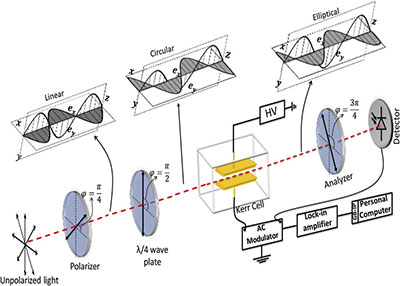
Electro-optic devices operate by altering the properties of light using an electric field. Depending on the application, these devices can change the phase, intensity, direction, wavelength, or polarization of light. This capability makes electro-optics indispensable in high-speed communications, laser modulation, precision metrology, optical sensing, and integrated photonics.
Common electro-optic systems utilize precision-engineered optical elements including lenses for focusing light, mirrors for beam steering, optical windows for environmental protection, prisms for beam splitting, and wave plates for polarization control. Together, these components provide exceptional optical performance while maintaining low distortion and high transmission efficiency.
Electro-Optic Lens Illustration
Applications of Electro-Optic Components
Modern electro-optic components are used throughout advanced technology industries. Researchers and engineers rely on these precision optics for:
- Laser optics and beam delivery systems
- Semiconductor inspection and wafer processing equipment
- Biomedical imaging and diagnostic instruments
- Fiber optic communications
- Infrared (IR) imaging systems
- Spectroscopy and optical metrology
- Machine vision and industrial automation
- Aerospace and defense optical systems
- Quantum optics and photonics research
Infrared Optical Materials
Infrared optical systems frequently utilize materials such as silicon, germanium, and zinc selenide (ZnSe) because of their excellent transmission characteristics in the infrared spectrum. These materials are commonly selected for thermal imaging cameras, CO2 laser optics, spectroscopy equipment, and high-power laser applications where visible optical materials cannot perform efficiently.
Why Researchers Choose UniversityWafer
UniversityWafer provides high-quality electro-optic components with custom dimensions, precision polishing, and excellent optical surface quality. Whether you need prototype quantities for laboratory research or production volumes for commercial systems, our team can help identify the right optical component for your application.
Electro-Optic Lenses, Windows, Prisms and IR Optics
UniversityWafer supplies custom electro-optic components for research, prototype development, photonics, optical testing, laser systems, imaging, infrared optics and production applications. Available parts include lenses, optical windows, prisms, mirrors, filters, wave plates, protective glass and IR materials such as silicon, germanium and zinc selenide.
Custom Optical Lens Specifications
Electro-optic lenses are available in concave, array and Fresnel designs for light shaping, focusing, beam control and optical device testing.
| Attribute | Specification |
| Outer Diameter | 0.1 mm - 800 mm |
| Thickness | ≥ 0.5 mm |
| Tolerance | ±0.01 mm |
| Surface Quality | 10/5 |
| Centration | 5" |
| Clear Aperture | 100% |
| Power / Irregularity | 1 / 0.2 |
| Bevel | 0.1 - 0.3 mm at 45° |
Concave Lens

Array Lens

Fresnel Lens

Optical Windows and Mirror Components
Optical windows protect sensitive systems while allowing light transmission. These components are used in laser assemblies, photonics devices, inspection tools, sensors and laboratory optical systems.
| Attribute | Specification |
| Outer Diameter | 0.5 mm - 800 mm |
| Thickness | ≥ 0.1 mm |
| Tolerance | ±0.01 mm |
| Surface Quality | 10/5 |
| Centration | 3" |
| Clear Aperture | 100% |
| Flatness | 1/20 |
| Bevel | 0.1 - 0.3 mm at 45° |
Wedge Mirror

Bevel Mirror

Wave Plate
Filter

Protective Glass

Liquid Guide Block
Custom Optical Prisms
Prisms are used to redirect, split, combine or disperse light in electro-optic systems. Custom prism options include glued prisms, right-angle prisms and special-shaped prisms.
| Attribute | Specification |
| Outer Diameter | ≥ 0.5 mm |
| Tolerance | ≥ 0.01 mm |
| Angle Tolerance | 10" |
| Surface Quality | 10/5 |
| Flatness | 1/15 |
| Bevel | 0.1 - 0.3 mm at 45° |
Glued Prism

Right-Angle Prism

Special-Shaped Prism

Infrared Optical Materials
Infrared optical components are available for red and IR applications using materials such as silicon, germanium and zinc selenide. These materials are commonly used in IR imaging, laser optics, spectroscopy, thermal sensing and optical research.
| Attribute | Specification |
| Outer Diameter | 0.1 mm - 800 mm |
| Thickness | ≥ 0.5 mm |
| Tolerance | ±0.01 mm |
| Surface Quality | 10/5 |
| Centration | 5" |
| Clear Aperture | 100% |
| Power / Irregularity | 1 / 0.2 |
| Bevel | 0.1 - 0.3 mm at 45° |
Silicon IR Optics
Germanium IR Optics

Zinc Selenide ZnSe Optics
