
Research Wafers for Postdoctoral Projects
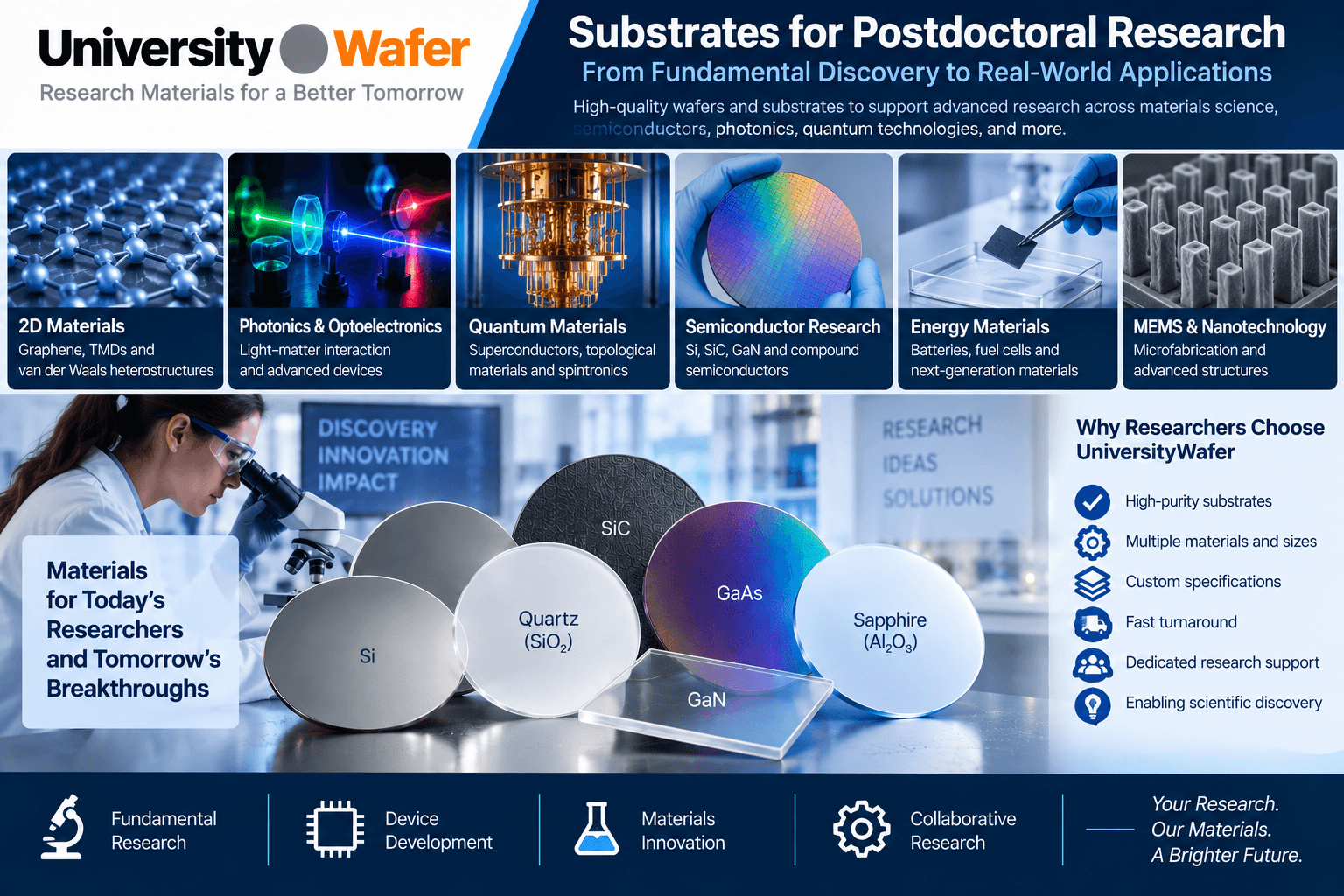
Postdoctoral researchers often need reliable substrates for advanced work in materials science, nanotechnology, semiconductors, MEMS, photonics, sensors, and quantum device research. UniversityWafer supplies wafers for university laboratories, national labs, startups, and industrial R&D teams.
Get Your Research Wafer Quote FAST! Or, Buy Online and Start Researching Today!
Wafers for Academic and Industrial R&D
Whether your project involves device fabrication, thin film deposition, photolithography, microfluidics, optical coatings, or electrical testing, our team can help match your research goals with the correct substrate specifications.
What Is a Postdoctoral Researcher?

A postdoctoral researcher, commonly called a postdoc, is a scientist or scholar who continues advanced research after earning a Ph.D. or equivalent doctoral degree. Postdoctoral positions allow researchers to develop specialized expertise, publish scientific papers, secure research funding, and prepare for careers in academia, government laboratories, or industry.
What Does a Postdoctoral Researcher Do?
Postdoctoral researchers work closely with principal investigators (PIs) while leading independent research projects. Depending on the laboratory and field of study, their responsibilities may include:
- Designing and conducting experiments.
- Analyzing experimental and computational data.
- Publishing articles in peer-reviewed scientific journals.
- Presenting research at conferences and seminars.
- Writing fellowship and grant proposals.
- Training graduate and undergraduate researchers.
- Collaborating with multidisciplinary research teams.
Preparing for a Postdoctoral Position
Finding the right postdoctoral position begins by identifying laboratories that align with your research interests. Many applicants contact potential faculty advisors before applying to discuss ongoing projects, available funding, and long-term career goals.
A competitive postdoctoral candidate typically has a strong publication record, technical expertise, excellent communication skills, and experience working collaboratively in a research environment. Familiarity with laboratory techniques, data analysis, and scientific writing is also highly valued.
Skills Developed During a Postdoc
Beyond conducting research, postdoctoral appointments help scientists develop leadership and professional skills needed for future careers. Many postdocs gain experience with:
- Project management
- Scientific writing
- Grant preparation
- Mentoring students
- Public speaking
- Collaborative research
Postdoctoral Fellowships
Many universities, government agencies, and private foundations offer postdoctoral fellowships that provide salary support, research funding, travel assistance, and professional development opportunities. Competitive fellowships allow researchers to pursue independent projects while expanding their publication record and professional network.
Career Opportunities After a Postdoc
Although many postdoctoral researchers pursue tenure-track faculty positions, others build successful careers in government research laboratories, semiconductor companies, biotechnology, pharmaceuticals, national laboratories, data science, scientific consulting, and research management.
Experience gained during a postdoctoral appointment demonstrates advanced technical knowledge, independent research ability, and leadership—qualities that are highly valued across both academic and industrial research organizations.
Why Postdoctoral Researchers Need High-Quality Substrates
Many postdoctoral researchers working in semiconductor physics, MEMS, photonics, nanotechnology, quantum devices, and materials science rely on high-quality research substrates for device fabrication and characterization. UniversityWafer supplies silicon wafers, SOI wafers, thermal oxide wafers, GaAs substrates, sapphire wafers, and many other materials used in advanced research laboratories worldwide.
Related Research Resources
- Silicon Wafers
- Silicon-on-Insulator (SOI) Wafers
- Silicon Epitaxial Wafers
- Thermal Oxide Silicon Wafers
- Sapphire Wafers
- Gallium Arsenide (GaAs) Wafers
- Silicon Carbide (SiC) Wafers
- Graphene Substrates
- Quantum Device Research
- Nanostructure Research
- Semiconductor Device Fabrication
- Photolithography
- Thin Film Deposition
- MEMS Fabrication
- Optoelectronics