
Get Your Silicon Carbide Wafer Quote FAST!
UniversityWafer supplies research-grade silicon carbide wafers, silicon wafers, SOI substrates, and specialty semiconductor materials for power electronics, EV chargers, solar inverters, electric motors, RF devices, and high-voltage research applications.
Get Your Quote FAST! Or, Buy Online and Start Researching Today!
Silicon Carbide Wafers for High-Power Electronics
Silicon carbide (SiC) wafers are used in power semiconductor research because they can support higher voltage, higher temperature operation, and faster switching than traditional silicon substrates. These properties make SiC useful for electric vehicles, renewable energy systems, industrial motor drives, power inverters, and high-efficiency energy conversion.
- High-voltage power devices
- Electric vehicle charging systems
- Solar inverter research
- Wind energy conversion
- Industrial motor drives
- RF power electronics
- Solid-state transformers
- High-temperature semiconductor devices
Why Researchers Use SiC Instead of Silicon
Compared with standard silicon wafers, silicon carbide substrates offer a wide bandgap, high breakdown strength, excellent thermal conductivity, and lower switching losses. These advantages allow SiC-based devices to run more efficiently and reduce cooling requirements in demanding power electronics applications.
Researchers often evaluate SiC wafers for next-generation MOSFETs, Schottky diodes, power modules, electric vehicle systems, and renewable energy conversion devices.
Related Wafer Materials
Need Custom SiC Wafer Specifications?
UniversityWafer can help researchers source SiC wafers and related semiconductor substrates for power electronics experiments, prototype devices, and high-voltage semiconductor research.
Buy Semiconductor Wafers Online or request a custom quote today.
Silicon Carbide Power Electronics Are Replacing Traditional Silicon Devices
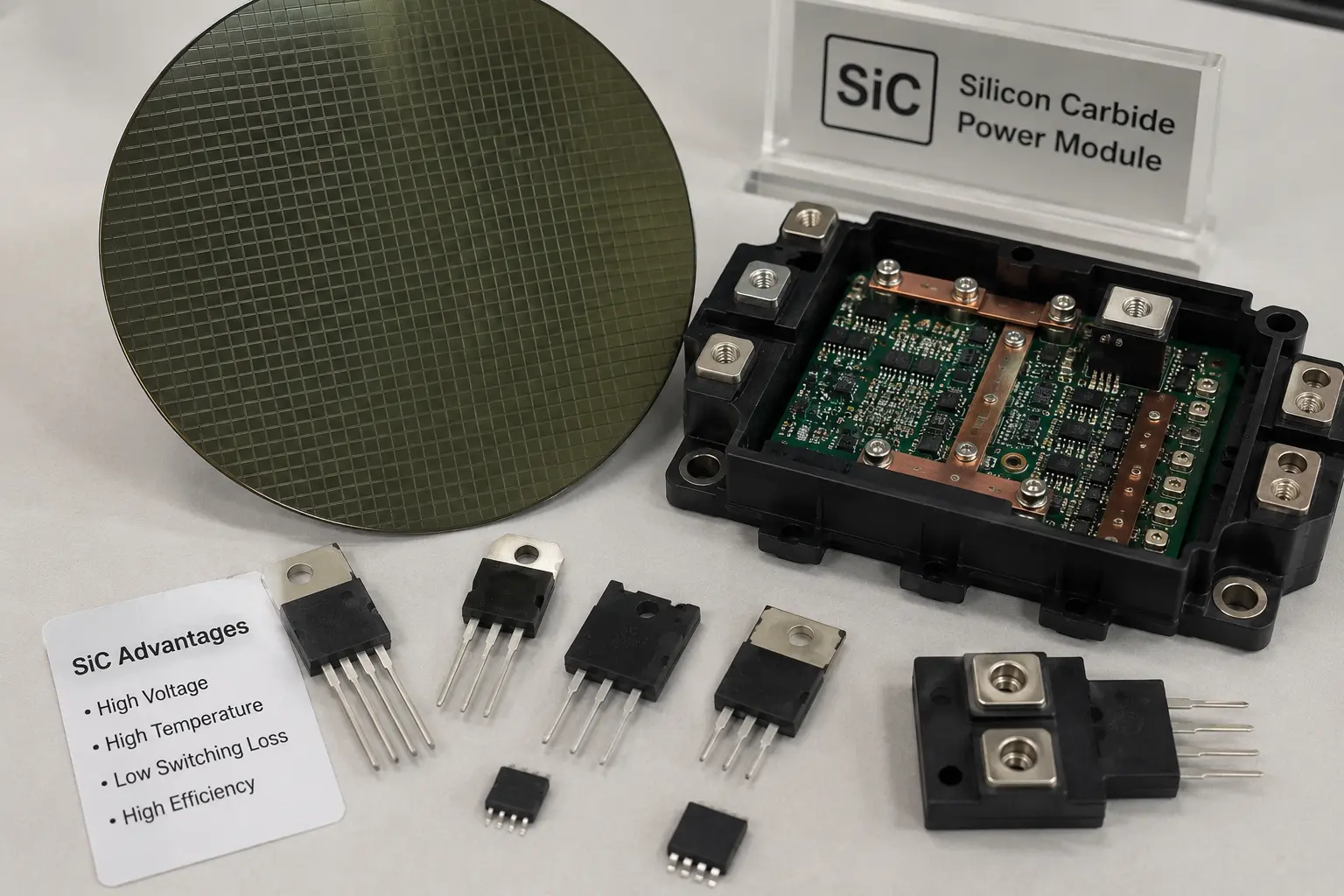
Global energy demand continues to increase as electric vehicles, renewable energy systems, data centers, industrial automation, and smart electrical grids require more efficient power conversion technologies. Researchers and semiconductor manufacturers are increasingly using silicon carbide (SiC) wafers because they can operate at higher voltages, higher temperatures, and higher switching frequencies than traditional silicon wafers.
Modern electrical systems rely heavily on power electronics to convert, control, and distribute energy. During AC-to-DC and DC-to-AC conversion, conventional silicon-based power devices can lose significant energy through heat generation and switching losses. Silicon carbide semiconductor devices help reduce these losses while improving energy efficiency, thermal management, and overall power density.
Compared with standard silicon substrates, silicon carbide power electronics can provide:
- Higher voltage handling capability
- Lower switching losses
- Improved thermal conductivity
- Higher energy conversion efficiency
- Faster switching speeds
- Smaller and lighter power modules
- Reduced cooling requirements
- Improved reliability in high-temperature environments
Silicon Carbide Wafers Are Superior to Silicon for These Applications
- Electric vehicles (EVs), EV chargers, and fast-charging stations
- Backup battery systems and data center power supplies
- Solar power inverters for DC-to-AC energy conversion
- Industrial electric motors and HVAC systems
- Electric transportation and railway systems
- Wind energy conversion systems
- Smart electrical grids and solid-state transformers
- RF power electronics and high-frequency switching systems
- Industrial motor speed controllers
- Aerospace and defense power electronics
Why Silicon Carbide Improves Power Electronics
Silicon carbide is classified as a wide-bandgap semiconductor material. Wide-bandgap materials can tolerate stronger electric fields and higher operating temperatures than conventional silicon devices. This allows SiC MOSFETs, Schottky diodes, and high-voltage semiconductor devices to switch faster and operate more efficiently.
Because of these properties, SiC power electronics are becoming increasingly important in:
- Renewable energy systems
- Electric vehicle power modules
- Industrial automation equipment
- High-voltage semiconductor devices
- RF semiconductor applications
- High-frequency power conversion systems
- Modern smart-grid infrastructure
Silicon vs Silicon Carbide for Power Electronics
Compared with traditional silicon substrates, silicon carbide wafers provide significantly improved thermal and electrical performance for modern power semiconductor applications.
| Property | Silicon | Silicon Carbide (SiC) |
|---|---|---|
| Bandgap | 1.1 eV | 3.26 eV |
| Breakdown Voltage | Lower | Much Higher |
| Thermal Conductivity | Moderate | Excellent |
| Switching Speed | Good | Very Fast |
| Power Loss | Higher | Lower |
Benefits of Silicon Carbide Power Systems
- Increased electric vehicle driving range
- Improved regenerative braking and fast charging
- Reduced energy loss during power conversion
- Smaller and lighter semiconductor modules
- Lower long-term operating costs
- Improved thermal efficiency and cooling performance
- Higher switching frequency capability
- Improved renewable energy efficiency