
200mm Silicon Wafers Help IoT Scientists Accelerate their Research
The use of 200mm silicon wafers in IoT fabrication has made it possible to reduce the cost of these components. With a lower cost of production and a reduced time to market, IoT manufacturers are looking for more affordable and scalable solutions. Consequently, 200mm wafers are now an increasingly popular choice for small-lot production.
Get Your 200mm Silicon Wafer Quote FAST! Or, Buy Online Today and Start Developing IoT Devices!
Related Semiconductor Research Topics
- MEMS Devices
- SOI Wafers
- 300mm Silicon Wafers
- Power Electronics
- Thin Film Deposition
- Semiconductor Manufacturing
- Silicon Wafers
Silicon Wafers Used to Fabricate IoT Devices
The growth of Internet of Things (IoT) connected devices has accelerated the development of advanced semiconductor technologies such as high-resolution image sensors, RF communication chips, MEMS devices, and system-on-chip (SoC) products. Modern silicon wafers are used to fabricate IoT sensors and connected electronics for automotive systems, industrial automation, medical technologies, smart appliances, and consumer electronics.
The automotive industry was among the first to adopt 200mm silicon wafers for IoT-related semiconductor manufacturing, and demand has since expanded into industrial and medical applications. The growing market for digital products is driven by “more-than-Moore” semiconductor devices that integrate sensors, RF communication, analog processing, and computing power onto a single chip platform.
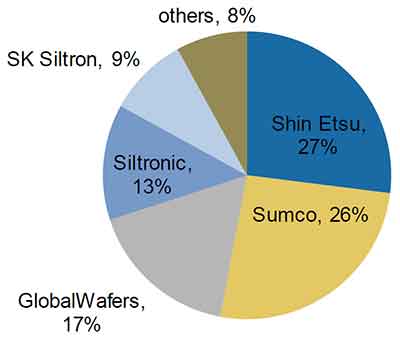 Current semiconductor fabrication facilities are operating near full capacity as demand for IoT electronics continues to rise. Many chip manufacturers are expanding or modernizing existing fabs to support higher production volumes of RF semiconductor devices, MEMS sensors, automotive electronics, and connected consumer products. Because building new fabs requires significant investment and equipment lead times, many manufacturers continue using mature 200mm wafer processes to support IoT device fabrication.
Modern semiconductor technologies remain highly compatible with both 300mm silicon wafers and 200mm wafer platforms. Many components used in smartphones, automotive electronics, wireless communication systems, and medical devices require analog and RF semiconductor technologies that are commonly fabricated on 200mm wafers. This manufacturing flexibility allows semiconductor fabs to continue meeting growing demand for connected technologies while maximizing existing production infrastructure.
Why 200mm Silicon Wafers Are Important for IoT Devices
200mm silicon wafers remain essential for IoT manufacturing because they provide a cost-effective and highly reliable platform for analog ICs, MEMS sensors, RF communication chips, and automotive semiconductor devices. Mature 200mm fabrication processes also support lower manufacturing costs and stable production yields for high-volume connected electronics.
- Lower semiconductor manufacturing costs
- Mature fabrication infrastructure
- Ideal for analog and RF semiconductor devices
- Strong compatibility with MEMS devices and sensors
- Widely used for automotive electronics
- Efficient production for connected consumer devices
- High production reliability and yield
The market for 200mm silicon wafers is expected to continue growing as IoT technologies expand into transportation, healthcare, industrial automation, and smart infrastructure. Increasing demand for connected devices will continue driving semiconductor innovation and wafer production growth over the next decade.
IoT technologies are expected to connect billions of devices worldwide, including wearables, smart appliances, industrial monitoring systems, autonomous vehicles, and intelligent healthcare equipment. As these technologies evolve, semiconductor manufacturers will require larger volumes of high-quality silicon substrates capable of supporting advanced microelectronics and sensor integration.
The growing demand for IoT semiconductor devices is driving significant investment in semiconductor manufacturing, advanced wafer processing, and thin-film deposition technologies. Future IoT systems will rely heavily on high-performance silicon wafers to enable faster communication, lower power consumption, and smarter connected technologies.