
What Wafers Are Used to Fabricate Quantum Cascade Laser Gas Sensors?
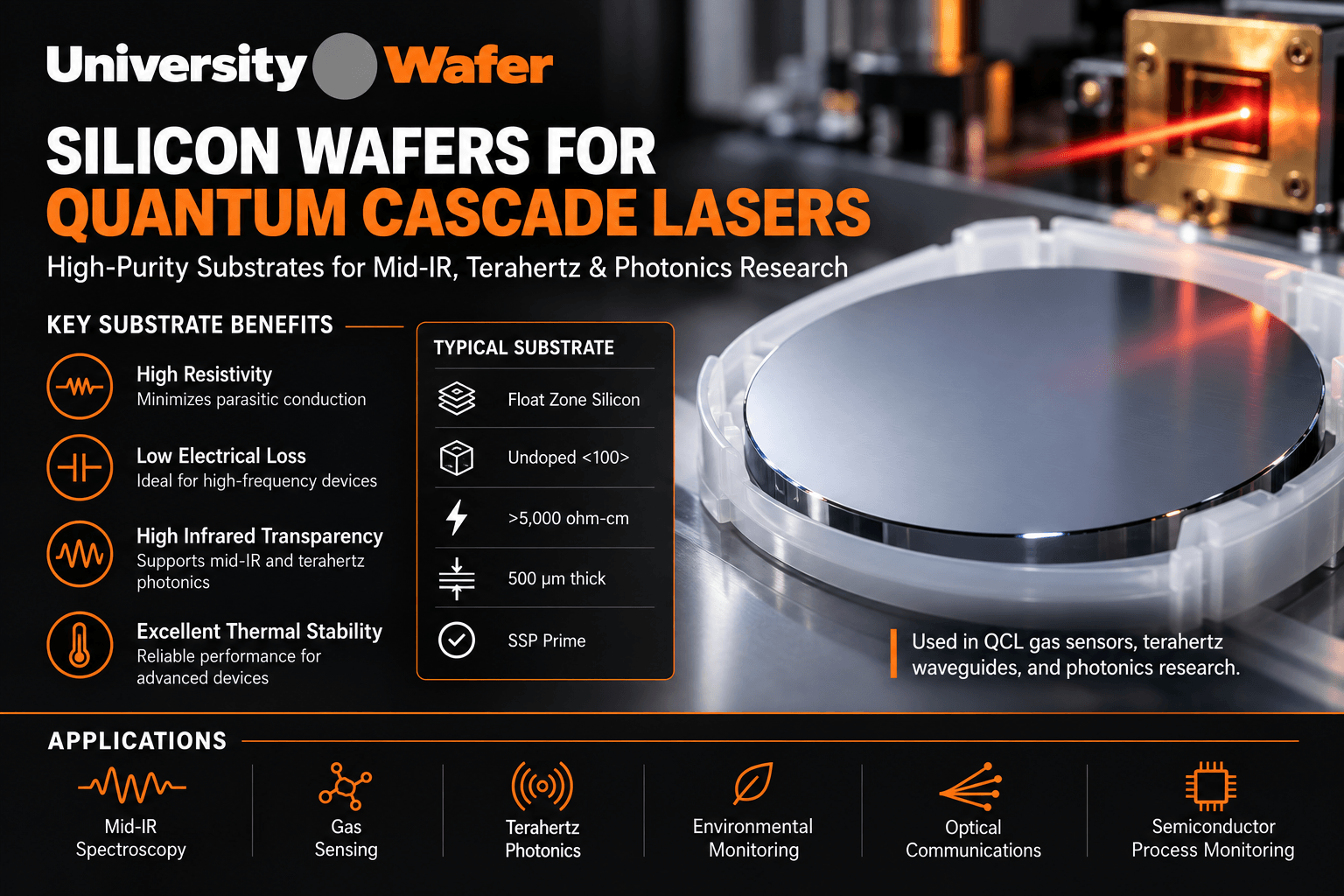
QCL laser chips are commonly grown from III–V heterostructures, including InGaAs/AlInAs layers on indium phosphide (InP) wafers for mid-infrared devices and GaAs/AlGaAs structures on gallium arsenide (GaAs) wafers for some terahertz devices. High-resistivity float-zone silicon wafers may be selected for supporting optics, waveguides, and components in QCL-based gas-sensing systems.
Compared to conventional laser systems, quantum cascade lasers are more compact, energy efficient, and capable of producing highly tunable mid-infrared radiation. Their narrow spectral linewidth and strong optical output make them ideal for molecular spectroscopy, industrial gas sensing, and trace chemical detection.
Example silicon wafer specified for QCL-related gas-sensor research:
76.2 mm undoped <100> float-zone silicon, >5,000 ohm-cm, 500 µm thick, SSP prime grade. Its suitability for a particular optical or terahertz component depends on wavelength, thickness, finish, and device design.
High-resistivity float-zone silicon can be useful in QCL-related infrared or terahertz optical assemblies because it offers:
- Low electrical loss
- Low absorption in suitable infrared and terahertz wavelength ranges
- Excellent thermal stability
- Reduced impurity concentration
- Potential for low-loss terahertz optical components when properly specified
For hybrid photonics research, SOI wafers and other silicon platforms can host passive optical components coupled to a separate III–V QCL source. The choice of InP, GaAs, or silicon depends on whether the part is the active laser, a waveguide, or a supporting optic.
Get Your Quote FAST! Or, Buy Online and Start Researching Today!
What Does QCL Stand For?
QCL stands for Quantum Cascade Laser, a semiconductor laser technology capable of generating coherent light in the mid-infrared and terahertz regions of the electromagnetic spectrum. Unlike conventional diode lasers, quantum cascade lasers generate photons through engineered electron transitions within semiconductor quantum well structures.
First demonstrated at Bell Laboratories in 1994, QCL devices quickly became important for spectroscopy, photonics, environmental monitoring, and infrared sensing applications because of their high optical efficiency and wavelength tunability.
Modern quantum cascade lasers are fabricated using multilayer semiconductor heterostructures and advanced nanofabrication techniques. Their optical waveguide architecture allows precise wavelength control and narrow spectral linewidth output.
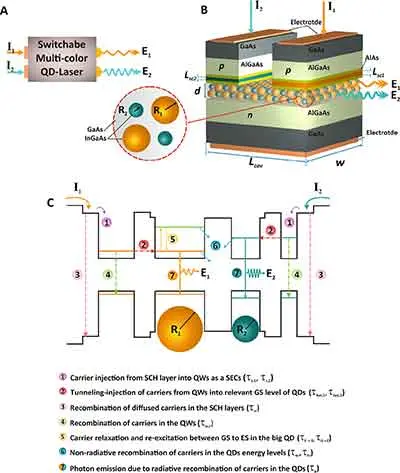 Quantum well lasers and quantum dot lasers are distinct semiconductor laser designs. QCLs instead use repeated quantum well stages and intersubband electron transitions. Researchers compare these device types for different optical communications, sensing, and photonics applications.
Quantum cascade lasers are commonly used in:
- Mid-infrared spectroscopy
- Gas sensing systems
- Terahertz imaging
- Defense and aerospace sensing
- Biomedical diagnostics
- Optical communications
- Semiconductor process monitoring
How Does a Quantum Cascade Laser Operate at Long Wavelengths?
Quantum cascade lasers operate at long wavelengths because they rely on intersubband electron transitions rather than electron-hole recombination. This allows engineers to design semiconductor structures capable of generating mid-infrared and terahertz radiation with extremely high wavelength precision.
QCL devices typically contain multiple alternating semiconductor layers forming quantum wells and optical waveguides. Electrons cascade through these engineered energy states, generating photons at each transition and producing highly efficient infrared light output.
Researchers use long-wavelength QCL systems for:
- Infrared spectroscopy
- Chemical sensing
- Terahertz communications
- Industrial process monitoring
- Security imaging systems
- Environmental gas analysis
The ability of QCL devices to operate at long wavelengths makes them especially valuable for detecting molecular absorption signatures and trace gas compounds.
How Do Quantum Dot Lasers Work?
Quantum dot lasers use nanoscale semiconductor particles that confine electrons and holes into discrete quantum states. This quantum confinement enables highly efficient light generation with reduced threshold current and improved temperature stability.
Compared to traditional semiconductor lasers, quantum dot laser structures provide:
- Higher optical efficiency
- Lower threshold current
- Improved wavelength stability
- Reduced thermal sensitivity
- Higher modulation speed
Researchers continue exploring quantum dot and quantum well semiconductor structures for next-generation photonics, terahertz devices, and integrated optical systems.
Advantages of Quantum Well Lasers
Quantum well lasers use ultrathin semiconductor active regions to improve carrier confinement and optical efficiency. These semiconductor structures are commonly fabricated on gallium arsenide, indium phosphide, and other compound semiconductor substrates; integration with silicon is also an active research area.
Advantages of quantum well laser devices include:
- High optical gain
- Compact device size
- Low power consumption
- Improved thermal performance
- Fast modulation capability
- Enhanced wavelength control
Modern quantum well and quantum cascade laser technologies continue driving advances in semiconductor photonics, infrared spectroscopy, and high-speed optical sensing systems.
What Are Quantum Cascade Laser Sensors Used For?
Quantum cascade lasers (QCLs) are highly efficient semiconductor lasers used in mid-infrared spectroscopy, gas sensing, terahertz imaging, photonics, and optical communications. Unlike conventional laser diodes, QCL devices generate light through intersubband transitions within semiconductor quantum well structures, enabling extremely precise wavelength control and high optical power output.
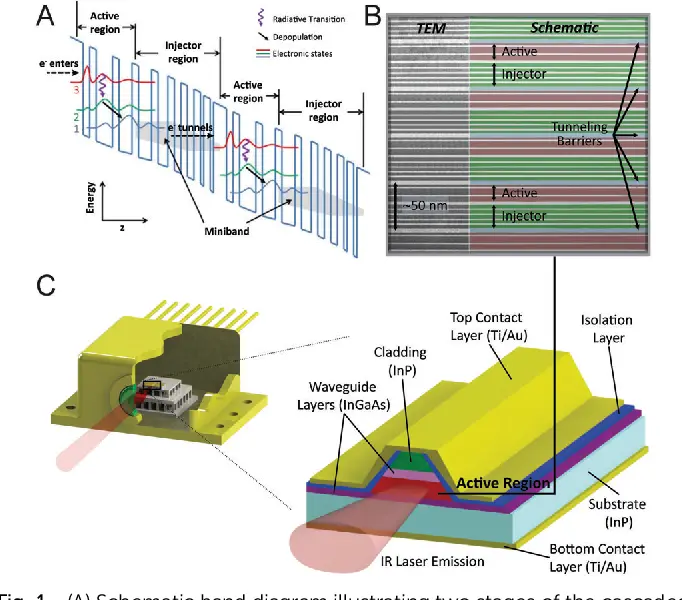
Since their development at Bell Labs in 1994 by Jerome Faist, Federico Capasso, Deborah Sivco, and Carlo Sirtori, quantum cascade lasers have become essential tools for chemical sensing, infrared spectroscopy, and environmental monitoring. Their ability to operate in the mid-IR and terahertz spectral regions makes them highly valuable for detecting trace gases, hazardous chemicals, and molecular compounds.
QCL sensors are widely used in:
- Gas detection systems
- Biomedical spectroscopy
- Industrial process monitoring
- Infrared imaging systems
- Optical communications
- Defense and security sensing
- Semiconductor photonics research
Applications of Quantum Cascade Laser Devices
Researchers use quantum cascade laser devices in spectroscopy, cryogenics, microscopy, optoelectronics, and nanotechnology applications. QCL systems provide narrow linewidth emission, high wavelength tunability, and strong optical output, making them ideal for advanced sensing and imaging technologies.
QCL semiconductor devices are frequently integrated with photonic chips, optical waveguides, and microfabrication platforms to improve device miniaturization and signal performance.
In semiconductor manufacturing, researchers have used QCL technology to:
- Improve microfabrication precision
- Enhance semiconductor inspection systems
- Develop nanoscale optical devices
- Create advanced infrared detectors
- Optimize material spectroscopy systems
Scientists are also exploring QCL integration with epitaxial silicon wafers, nanowires, and thin-film semiconductor structures for next-generation photonics applications.
What Are Terahertz Quantum Cascade Lasers?
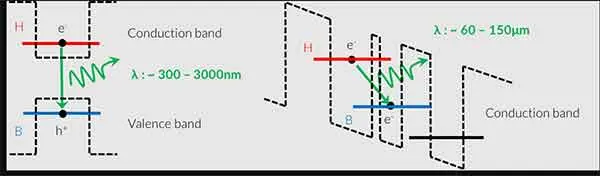 Terahertz quantum cascade lasers (THz QCLs) generate coherent terahertz radiation for imaging, spectroscopy, and high-frequency sensing applications. Researchers have developed THz QCL devices capable of producing extremely high output power while maintaining narrow spectral linewidths.
The terahertz spectral region is especially useful for:
- Non-destructive material inspection
- Security screening systems
- Biochemical sensing
- Semiconductor characterization
- High-speed wireless communications
- THz spectroscopy research
THz QCL active regions are often based on GaAs/AlGaAs or other III–V heterostructures. Separately, high-resistivity silicon wafers may be used in external terahertz optical components and measurement setups; see the related terahertz spectroscopy substrates.
What Does a Quantum Cascade Laser Do?
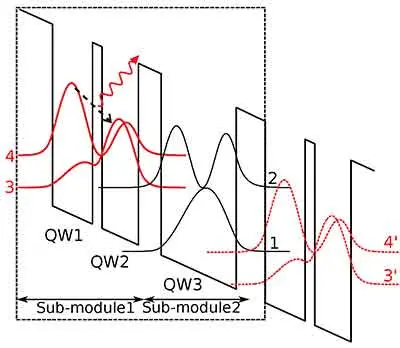 A quantum cascade laser is a semiconductor device designed to generate coherent light in the mid-infrared or terahertz region of the electromagnetic spectrum. Unlike conventional semiconductor lasers that rely on electron-hole recombination, QCL devices generate photons through electron transitions between engineered quantum well energy states.
This structure allows QCLs to achieve:
- High optical efficiency
- Narrow spectral linewidth
- Broad wavelength tunability
- High-speed modulation capability
- Strong infrared output power
Quantum cascade lasers are widely used in trace gas analysis, molecular spectroscopy, environmental monitoring, and defense technologies because they can detect extremely small concentrations of gases and chemicals.
How Do Quantum Well Lasers Work?
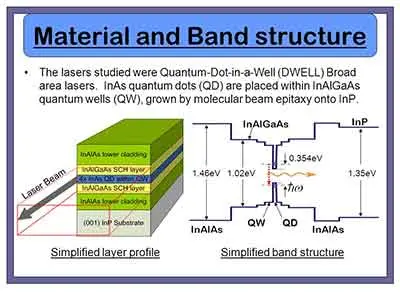 Quantum well lasers use ultrathin semiconductor layers to confine electrons and holes into discrete quantum energy states. This quantum confinement improves optical efficiency, lowers threshold current, and enables compact high-power laser devices.
Quantum well laser structures are typically grown by epitaxial methods on compound semiconductor substrates such as GaAs or InP. Silicon and SOI wafers may be used for separate or hybrid photonic integration.
Advantages of quantum well laser technology include:
- Low threshold current
- High optical gain
- Improved temperature stability
- Compact device architecture
- High modulation speeds
Quantum well lasers and quantum cascade lasers continue to drive innovation in semiconductor photonics, optical sensing, and infrared imaging systems.
Silicon Wafers Used for Terahertz QCL Research
Ultra-thin silicon wafers can be evaluated for supporting optical or photonic components in terahertz QCL research. Their role and suitability depend on the system design; the QCL gain medium itself is a semiconductor heterostructure. See ultra-thinned silicon wafer specifications.
Buy Ultra-Thin Silicon Wafers Online
Applications of Quantum Cascade Lasers
Quantum cascade lasers are studied in industrial, scientific, and medical applications because their engineered emission wavelength can target molecular absorption bands in the infrared.
Common QCL applications include:
- Mid-infrared spectroscopy
- Trace gas detection
- Environmental sensing
- Medical diagnostics
- Infrared microscopy
- Defense and aerospace technologies
- Optical communications
- Semiconductor process monitoring
Because QCL systems can generate high optical power with narrow linewidth emission, they are considered one of the most important semiconductor laser technologies for modern spectroscopy and photonics research.