
I'm interested in fabricating black-silicon nanowires via dry-etch (RIE with SF6/O2/Ar). The fabrication protocol I'm hoping to follow says that they used "unpolished" <100> n-type silicon substrates, and that the unpolished finish is crucial to reproducibility of the generated black-silicon features between wafers. Would the As-cut silicon wafers work for this purpose, or could you advise me on which wafers may be best suited to this? Please also provide pricing.
What Silicon Wafer Spec is Used in Silicon Nanowires?
SiNWs nanowires have used P-type (100) silicon wafers with 300 nm heat-resistant oxides having low-gated Ti/Au (10/200 nm) gate electrode. A silicon nanowire array was employed as the substrate for covalently bonding different fluoroionophores to detect heavy metal ions since it allows for higher carrier mobility, hence higher sensitivity for the analytes that are adsorbents at their surfaces.
Get Your Quote FAST! Or, Buy Online and Start Researching Today!
Key Terms of Silicon Nanowires Research
- silicon nanowires
- nanowire arrays
- nanowire matrix
- nanowire structures
- sinws nanowires
- semiconductor nanowire
- nanowire solar
- nanowires possess
- nanowire type
- fabricated nanowires
- ratio nanowires
- nanolithography techniques
- silicon wafers
- nanoelectronic memory
- silicon materials
Silicon Nanowire Arrays
A silicon nanowire array is a collection of super-thin silicon wires, all organized neatly in a specific pattern or structure. Imagine a bed of nails, but instead of nails, you have these tiny wires, each much thinner than a human hair. They're all standing close together in an orderly fashion.
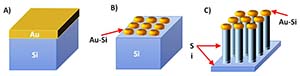
What substrates are used to fabricate silicon nanowire arrays?
Si Item #763
50.8mm P/B <100> 1-10 ohm-cm 275um SSP Prime
How to Fabricate Black-Silicon Nanowires?
A PhD candidate requested the following quote:
Reference # 276538 for specs and pricing.
Related Silicon Nanowire Resources
Functionalizing Silicon Nanowires for Sensor Applications
Silicon
nanowires are a type of
semiconductor nanomaterial that is typically formed by catalyzed growth or
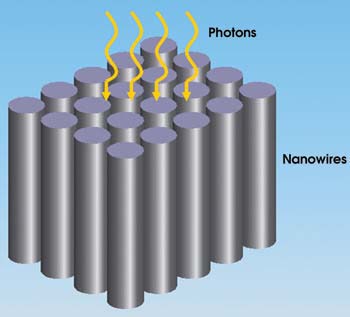 etching of solid from the liquid or vapor phase. These nanomaterials exhibit remarkable properties that aren't present in bulk 3-dimensional
silicon materials such as high Young Modulus and tensile strength. They are also used for applications such as lithium ion batteries and thermoelectrics.
etching of solid from the liquid or vapor phase. These nanomaterials exhibit remarkable properties that aren't present in bulk 3-dimensional
silicon materials such as high Young Modulus and tensile strength. They are also used for applications such as lithium ion batteries and thermoelectrics.
Due to their unique characteristics such as biocompatibility, tunable optical and electrical properties, and high surface-to-volume ratio, nanowires are ideal for sensor devices. They can be made into field-effect transistor (FET) based sensors, which are sensitive to gases, ions, DNA, proteins and many other chemicals. In addition, they can be arranged in a crossed architecture to form resonators, which have the capability of producing extremely high oscillating frequencies.
Nevertheless, in order to utilize SiNWs as sensing elements in real applications, the physical/chemical properties must be modified to enhance their sensitivity and selectivity. This can be done by functionalizing the oxidized silicon surfaces on which the SiNWs reside. Several techniques have been developed to deposit organic layers or doping agents onto the silicon surfaces. Among them, silanization is the most popular technique.
To demonstrate the potential of functionalized silicon nanowires in sensor applications, Yang et al. designed a humidity sensor utilizing Te-modified H-terminated SiNWs. The authors reported that the resonant frequency of the device was strongly dependent on humidity. In fact, the resonance frequency shifted by 35 MHz at higher relative humidity.
Video: Silicon Nanowires Detect Explosions
How to Design Silicon for Use in Optical Sensors
When considering optical sensors, one important consideration is the type of
silicon used in the sensor.
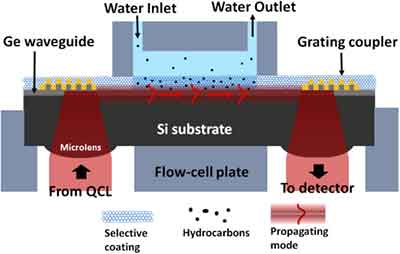 Silicon is widely used for optical sensors, such as those used for spectroscopy. Typically, a sensor is made of a thin film of silicon or another material, such as an organic semiconductor. For example, the optical response of a 10 nm thick biolayer is characterized by a slope of 100 nm/RIU.
Silicon Nanowire SiNW
The symbol for Silicon Nanowires is (SINW) The emergence of this new material as an alternative to bulk silicon has brought numerous advantages. In addition to its high-quality amplification, it has excellent optical properties. However, despite its advantages, it is not without its drawbacks. Unlike bulk silicon, which is susceptible to corrosion and oxidation, SiNWs are resistant to ultraviolet rays and have a small optical band gap.
The process used to produce SiNWs involves two microlithography steps. The first is the bottom-up method, which involves growing SiNWs from a silicon wafer, followed by a metal-catalyzed reaction. The second method, which is known as the top-down method, begins with a bulk silicon wafer and trims it to the required size and shape.
A bottom-up approach is a more efficient technique for the fabrication of SiNWs. The bottom-up approach
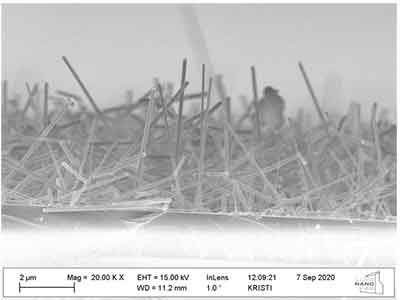 requires a more sophisticated
lithography technique, while the top-down approach requires a less expensive method.
requires a more sophisticated
lithography technique, while the top-down approach requires a less expensive method.
A fully compatible CMOS optical sensor is designed around this principle.
PSi sensors
CMOS and SOI technologies are both silicon-based.
Silicon is used in optical sensors due to its high refractive index and wide range of wavelength. Silicon is a good material for this application because it is cheap and can be used to build optical sensors with high sensitivity.
How to Fabricate Silicon Optical Sensors?
The fabrication of silicon used in optical sensors involves a number of different technologies. During the deposition process, two successive layers of glass particles are deposited on the Si substrate.
The fabrication process flow involves the formation of n+ diffusion and p+ ion implantation areas on the silicon wafer.
How to Design Silicon Nanowires (SiNWs)
The present study investigates the design of SiNWs for use in optical sensors.