Suprasil Quartz for NIR Applications
A microelectronics researcher requested help with the
I am from the microelectronics research group. We are in need of Suprasil or Infrasil Quartz wafer from you. Please let us know the pricing , flatness, thickness of these wafers .
We are planning to use them for the NIR applications so they are required to be transmitting in the range of 300nm - 3um . Please send us the optical transmission spectrum along with the quote.
We are also open to fused Silica wafers if they meet the optical transmission range.
We have some Infrasil 301 but this is the size, the material will work but I am not sure they can use the size we have:
Window, Infrasil 301
OD: 2.500” +/-.015”
THK: .035” +/-.001”
Both Sides Polished
SQ: 20/10
Reference #139070 for specs and pricing.
Get Your Quartz Quote FAST! Or, Buy Online and Start Researching Today!
Synthetic Quartz Glass Plate
A purchasing officer requested the following quote:
I am trying to find a synthetic Quartz glass plate of the following dimensions: - Length: 700mm - Width: 133mm - Thickness: 2mm Or alternatively: - Length: 350mm - Width: 113mm - Thickness: 5mm Could you please let me have a quote for these or anything you have that might be close? When we refer to synthetic quartz we are used to using Suprasil tube from Heraeus Quartz glass. Is it a product that is familiar to you or do you have access to an equivalent?
Reference #155781 for specs and priicng.
Suprasil Fused Silica Roughness Spec
A physics PhD candidate requested the following quote:
We are interested in buying t fused silica (something like Suprasil or VIOSIL, which some of our colleagues have bought from you in the past).
We need technical specs on the smoothness of the fused silica surface (like RMS roughness) as it is very important to our decision making process. We will not be able to make a decision on buying fused silica pieces without it.
Referene #156190 for specs and pricing.
What is VIOSIL Fused Silica?
VIOSIL is a high-purity natural fused silica used in general-purpose optical and industrial applications where extreme UV transparency and the highest purity are not required. It is often chosen for its cost-effectiveness in less demanding environments.
- Industrial applications such as lamp envelopes, and semiconductor manufacturing.
- Optical components that do not require the highest purity levels or UV transparency.
- General-purpose optics and windows where cost-effectiveness is important.
What is Suprasil?
Suprasil is a brand name for a range of high-purity synthetic fused silica materials. These materials are known for their exceptional optical clarity and low impurity content, making them suitable for various high-performance optical and industrial applications.
Key properties of Suprasil include:
- High Purity: Suprasil is made from ultra-pure raw materials, resulting in
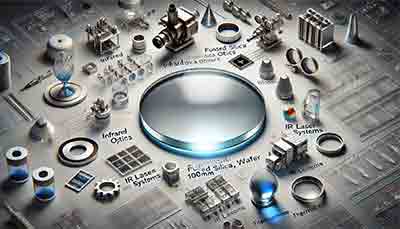 minimal impurity levels.
- Excellent Optical Transparency: It has high transparency in the ultraviolet (UV) to infrared (IR) spectral ranges.
- Low Thermal Expansion: Suprasil has a low coefficient of thermal expansion, making it stable under varying temperature conditions.
- High Damage Threshold: It can withstand high laser power and energy densities, making it suitable for high-power laser systems.
- Chemical Resistance: Suprasil is resistant to most chemicals and does not react with most substances.
Applications of Suprasil include:
- High-performance optics, such as lenses, windows, and prisms.
- Semiconductor manufacturing, particularly in photolithography.
- Laser systems, especially in UV and high-power lasers.
- Scientific instrumentation requiring high-precision optical components.
Overall, Suprasil is valued for its superior optical properties and durability in demanding environments.
What Is The Difference Between Suprasil and Infrasil Fused Silica?
Suprasil and Infrasil are both types of high-purity fused silica materials produced by Heraeus, but they are optimized for different applications based on their specific properties. Here are the key differences between them:
Suprasil
-
Composition and Purity:
- Suprasil is made from synthetic fused silica, which has extremely high purity levels.
- It is known for its very low levels of impurities and hydroxyl (OH) content.
-
Optical Properties:
- Suprasil offers excellent optical transparency across a broad spectral range, from the deep ultraviolet (UV) to the near-infrared (NIR).
- It is particularly valued for its high transmission in the UV region, making it suitable for applications requiring UV transparency, such as UV lasers and optics.
-
Thermal Properties:
- It has a very low coefficient of thermal expansion, ensuring stability and minimal distortion under thermal stress.
-
Applications:
- High-performance optics (lenses, windows, prisms).
- UV laser optics and photolithography.
- Scientific instrumentation requiring precise optical properties.
Infrasil
-
Composition and Purity:
- Infrasil is also made from high-purity fused silica, but it is optimized differently compared to Suprasil.
- It generally contains slightly higher levels of impurities than Suprasil but is still highly pure.
-
Optical Properties:
- Infrasil is specifically optimized for infrared (IR) applications.
- It has high transmission in the IR region, particularly between 1.2 to 3.5 micrometers, making it suitable for applications where IR transparency is critical.
-
Thermal Properties:
- It also exhibits low thermal expansion and high thermal stability, though its optimization for IR applications might slightly alter its thermal performance compared to Suprasil.
-
Applications:
- Infrared optics (IR lenses, windows, and prisms).
- IR laser systems and IR spectroscopy.
- Thermal imaging systems and sensors.
Summary
- Suprasil is best suited for applications requiring high UV to NIR transparency, such as UV laser optics and high-precision scientific instruments.
- Infrasil is optimized for IR applications, making it ideal for IR laser systems, IR spectroscopy, and thermal imaging.
Both materials offer excellent thermal stability and chemical resistance, but their specific optimizations make them more suitable for their respective spectral ranges.
What Are NIR Applications?
NIR (Near-Infrared) applications refer to the use of near-infrared light, typically in the wavelength range of 700 to 2500 nanometers (nm), in various technological and scientific fields. Here are some key NIR applications:
1. Medical and Biological Imaging
- NIR Spectroscopy: Used for non-invasive analysis of biological tissues, detecting concentrations of substances like glucose, oxygen, and hemoglobin.
- Optical Coherence Tomography (OCT): A non-invasive imaging technique used in ophthalmology to obtain detailed images of the retina.
2. Agriculture and Food Industry
- NIR Spectroscopy: Employed to determine the composition and quality of agricultural products, such as moisture, protein, and fat content in grains, fruits, and vegetables.
- Hyperspectral Imaging: Used for monitoring crop health, detecting diseases, and assessing soil properties.
3. Industrial Applications
- Material Identification: NIR spectroscopy helps in identifying and sorting different types of plastics and materials in recycling processes.
- Process Monitoring: Used for real-time monitoring and control of industrial processes, such as the moisture content in pharmaceuticals and food products.
4. Environmental Monitoring
- Remote Sensing: NIR sensors on satellites and drones are used to monitor vegetation health, water quality, and land use changes.
- Air and Water Quality Analysis: NIR spectroscopy helps in detecting pollutants and analyzing environmental samples.
5. Security and Surveillance
- Night Vision: NIR technology is used in night vision cameras and goggles for enhanced visibility in low-light conditions.
- Biometric Identification: NIR imaging is used in facial recognition systems and iris scanners.
6. Telecommunications
- Fiber Optics: NIR wavelengths are commonly used in fiber optic communications, providing high-speed data transmission over long distances.
7. Art and Archaeology
- Art Restoration: NIR imaging helps in examining underdrawings and previous restorations in artworks.
- Archaeological Analysis: Used to study pigments and materials in ancient artifacts and structures.
8. Scientific Research
- Astronomy: NIR telescopes are used to observe celestial objects that are not visible in the visible spectrum, such as distant galaxies and star-forming regions.
- Chemical Analysis: NIR spectroscopy is used for qualitative and quantitative analysis of chemical compounds in research laboratories.
These applications highlight the versatility and importance of NIR technology across various fields, enabling advancements in diagnostics, monitoring, and analysis.
