
Poly Si Thin Film Growth
We have the expertise to help you with your research. Send us your specs and quantity today!
Get Your Poly-Si Thin Film Wafer Quote FAST! Or, Buy Semiconductor Research Wafers Online Today .
Model Calibration of Poly-Si Thin Film Growth
Model calibration is an important part of polycrystalline silicon thin film research and semiconductor process development. Researchers use computational modeling and experimental calibration techniques to predict thin film thickness, growth rate, mobility, and material performance during deposition.
Accurate calibration models help improve process repeatability, reduce defects, and optimize thin film uniformity for semiconductor manufacturing and microfabrication applications.
 Thickness uniformity is one of the most important factors in poly-Si thin film deposition. Uneven thickness distribution can reduce device performance, lower manufacturing yield, and increase process development costs. Maintaining consistent film thickness becomes even more important when the substrate surface has complex topography or patterned structures.
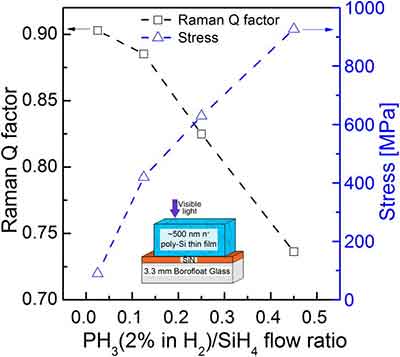
Improved thin film uniformity helps increase wafer usability, process stability, and semiconductor device reliability. Thin film characterization methods such as microscopy, Raman analysis, and electrical measurements are often used to evaluate film quality and calibration accuracy.
Poly-Si Thin Film Deposition Processes
Poly-Si thin film growth usually begins with substrate preparation and cleaning. The substrate is commonly rinsed using deionized water and prepared for thin film deposition inside a controlled semiconductor processing environment.
Several deposition methods can be used for poly-Si thin film fabrication, including molecular beam epitaxy (MBE), chemical vapor deposition (CVD), low-pressure chemical vapor deposition (LPCVD), and other semiconductor thin film growth techniques.
During deposition, process parameters such as temperature, chamber pressure, gas flow, deposition rate, and substrate preparation are carefully controlled to achieve uniform thin film growth and stable electrical properties.
Epitaxial Growth and Semiconductor Substrates
Many thin film deposition systems use epitaxial growth techniques to create highly controlled semiconductor layers. Materials such as GaAs, InGaAs, and silicon-based substrates are commonly used in semiconductor and photonics research.
Silicon epitaxy and thin film deposition processes are widely used for MEMS fabrication, integrated circuits, photonics, semiconductor sensors, and advanced microelectronic devices.
Applications of Poly-Si Thin Films
Poly-Si thin films are used in a wide range of semiconductor and thin film applications because they provide good electrical properties and compatibility with semiconductor manufacturing processes.
- Thin film transistors (TFTs)
- MEMS fabrication
- Integrated circuits
- Semiconductor sensors
- Solar cells
- Microelectronic devices
- Photonics research
- Wafer-level semiconductor processing
Thin Film Calibration Software
Software systems are important for monitoring and calibrating thin film deposition processes. Modern semiconductor deposition systems often include automated scheduling, recipe management, process monitoring, and real-time calibration tools.
Accurate software control helps researchers maintain deposition consistency, improve throughput, and optimize semiconductor process development for demanding thin film applications.