Research Request:
The researcher requested silicon pieces with a specific thickness for metamaterial measurements.
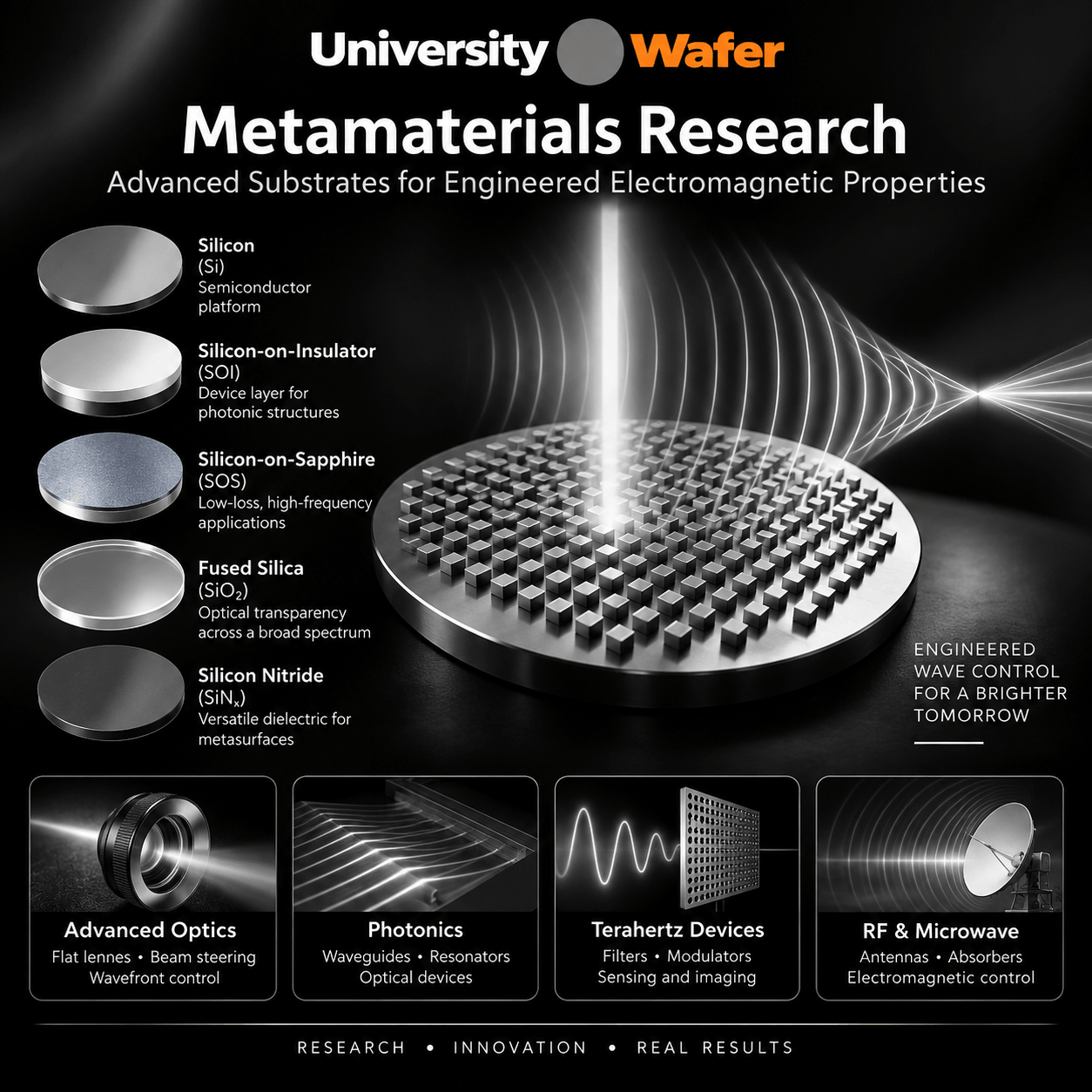
Metamaterials are engineered structures designed to manipulate electromagnetic waves in ways that conventional materials cannot. Researchers use specialized silicon wafers, SOI, silicon-on-sapphire, fused silica, and silicon nitride substrates to fabricate metamaterials and metasurfaces for applications in photonics, terahertz devices, sensing, imaging, and advanced optics. UniversityWafer supplies research-grade substrates in a wide range of specifications to support metamaterial fabrication and development.

Silicon is widely used in metamaterials, metasurfaces, photonics, and terahertz research because it is compatible with established microfabrication and nanofabrication processes. Depending on the experiment, researchers may require specific wafer dimensions, crystal orientations, resistivity ranges, thicknesses, or surface finishes.
A PhD candidate working at a metamaterials research center requested small silicon substrates for metamaterial measurements. The requested material demonstrates how custom-cut silicon pieces can be useful when a full wafer is not required for an experiment.
Research Request:
The researcher requested silicon pieces with a specific thickness for metamaterial measurements.
Suggested specification:
Reference #121042 for specifications and pricing.
Silicon-on-insulator (SOI) wafers are particularly useful for silicon photonics and nanophotonics because they provide a crystalline silicon device layer separated from the silicon handle wafer by a buried silicon dioxide (BOX) layer.
The device layer can be patterned into waveguides, resonators, gratings, metasurfaces, and other subwavelength photonic structures. The device-layer and BOX thicknesses are important design parameters and should be selected for the intended optical wavelength and device geometry.
Research Request:
A researcher working on photonic metamaterial devices requested an SOI wafer with a 320nm silicon device layer and a 1µm buried oxide layer and asked whether the device-layer thickness could be special ordered.
Custom SOI specifications can be useful when a photonic design requires a particular silicon device-layer thickness that is not available in standard inventory.
Reference #141129 for specifications and pricing.
Silicon-on-sapphire (SOS) consists of a crystalline silicon layer on an electrically insulating sapphire substrate. SOS can be considered for specialized RF, microwave, terahertz, photonic, and device research, depending on the required electrical and optical properties.
Research Request:
One researcher requested 4-inch SOS wafers, or smaller 2-inch wafers, for metamaterials research and specified a very low silicon-layer resistivity.
Electrical resistivity can be an important parameter when the silicon layer participates in the electromagnetic response of a device. The appropriate value depends on the device architecture, frequency range, and intended experiment.
Reference #218458 for specifications and pricing.
Fused silica wafers are useful substrates for many optical and terahertz experiments because of their optical properties, electrical insulation, thermal stability, and compatibility with thin-film deposition and lithographic fabrication.
Metallic structures made from materials such as gold (Au) can be patterned on fused silica to form resonators and other metamaterial structures. Their electromagnetic response can then be characterized using appropriate spectroscopy techniques, including terahertz spectroscopy when the structures are designed for THz frequencies.
Research Request:
A researcher requested eight 4-inch, double-side-polished JGS1 fused silica wafers with a specified thickness for fabrication involving gold metamaterials and characterization with a terahertz spectrometer.
Reference #261819 for specifications and pricing.
There is no single substrate that is best for every metamaterial. Substrate selection should be based on the operating wavelength, fabrication process, device architecture, patterned material, and required electrical or optical properties.
Researchers may need to consider:
UniversityWafer can supply standard and custom substrates for metamaterials, metasurfaces, nanophotonics, terahertz devices, and related research.
Get Your Metamaterials Substrate Quote FAST! Or, Buy Online and Start Researching Today!
Metamaterial performance depends not only on the patterned nanostructures but also on the substrate and thin-film materials used during fabrication. Researchers commonly require substrates with controlled thickness, low surface roughness, high optical quality, and material properties suited to the operating wavelength.
UniversityWafer supplies substrates for metamaterials, metasurfaces, nanophotonics, terahertz devices, optical components, and electromagnetic research. Available materials include silicon, SOI, silicon-on-sapphire, fused silica, and wafers with deposited dielectric films such as silicon nitride.
Silicon nitride (SiNx) on fused silica is useful for optical metasurface research because the silicon nitride layer can be patterned into nanoscale structures while the fused silica provides a transparent optical substrate.
Depending on the experiment, researchers may specify properties such as:
Film thickness, refractive index, stress, surface quality, and substrate specifications should be selected according to the intended wavelength and device design.
One researcher contacted UniversityWafer looking for approximately 600–700nm of silicon nitride on double-side-polished 100mm fused silica wafers. The intended application was fabrication of nanoscale structures for optical metasurfaces.
The researcher had previously fabricated a metasurface lens operating at a 1064nm wavelength using an amorphous silicon layer patterned on fused silica. This type of research illustrates how the substrate, deposited film, and nanostructure geometry work together to produce the desired optical response.
Reference #258731 for the original requested specifications and pricing.
Metamaterials obtain their electromagnetic response primarily from their engineered structures. For metasurfaces, arrays of subwavelength features can be designed to control properties such as the phase, amplitude, polarization, and propagation of light.
The substrate can influence fabrication and device performance, which makes several characteristics important:
Fused silica provides high optical transparency across a broad spectral range and is widely used for optical metasurfaces, nanophotonics, lenses, and other photonic structures.
Silicon substrates are widely used in semiconductor-compatible fabrication and can support research involving infrared photonics, resonators, sensors, and micro- and nanostructured devices.
SOI wafers provide a crystalline silicon device layer separated from the silicon handle wafer by a buried oxide layer. This structure is commonly used for silicon photonics, optical waveguides, resonators, and integrated nanophotonic structures.
Silicon-on-sapphire combines a crystalline silicon layer with an electrically insulating sapphire substrate and can be useful for specialized RF, photonic, sensor, and device research.
Silicon nitride thin films are used extensively in photonics and nanofabrication. SiNx layers can be deposited on fused silica or silicon-based substrates and patterned to create waveguides, resonators, metasurfaces, and other optical nanostructures.
Metamaterial research often requires specifications that are not available as standard inventory. UniversityWafer can help researchers source wafers and substrates with specific diameters, thicknesses, orientations, surface finishes, dielectric layers, and thin-film requirements.