Photovoltaic Substrates for Underwater Solar Energy Research
Researchers developing underwater photovoltaic systems often require advanced semiconductor substrates and high-efficiency solar cells optimized for marine environments, underwater light transmission, and reduced infrared absorption. Common materials used for underwater solar energy harvesting include gallium arsenide (GaAs), GaInP, and germanium (Ge) based photovoltaic structures.
Researcher Request:
Our research group is focused on underwater solar energy harvesting and underwater photovoltaic power systems. We are looking for photovoltaic cells with a bandgap between 1.8 eV and 2.3 eV to optimize visible light absorption underwater.
We are especially interested in:
- Gallium Indium Phosphide (GaInP)
- Gallium Arsenide (GaAs)
- GaInP/GaAs/Ge triple junction solar cells
- Dual junction photovoltaic cells
The underwater solar module should provide approximately 12V output, remain below 1 square meter in size, and operate efficiently in submerged marine environments.
Because underwater light absorption changes significantly with water depth, researchers often require customized photovoltaic solutions depending on operating conditions. Triple junction (TJ) solar cells are commonly recommended for shallow water environments, while dual junction (DJ) solar cells may perform more efficiently at greater depths due to reduced infrared light transmission.
Scientists performing underwater photovoltaic research frequently request:
- GaAs photovoltaic substrates
- GaInP semiconductor structures
- Germanium solar cell substrates
- Triple junction solar cells
- Dual junction photovoltaic cells
- Water-resistant solar encapsulation
- Anti-algae protective coatings
- Marine-grade electrical connections
Get Your Quote FAST! Or,
Buy Online
and Start Researching Today!
UniversityWafer, Inc. Response
After reviewing the scientific literature and underwater absorption spectra, different photovoltaic structures were recommended depending on the operating water depth.
For shallow underwater environments, triple junction (TJ) solar cells may provide improved efficiency due to broader spectral absorption. For deeper water operation, dual junction (DJ) photovoltaic structures are often more effective because infrared wavelengths are rapidly absorbed by seawater.
Researchers found that germanium junctions may contribute limited efficiency underwater because infrared radiation penetration decreases significantly with depth. As a result, dual junction GaAs/(Al)GaInP semiconductor structures may provide better overall performance for underwater photovoltaic applications.
Additional underwater photovoltaic options may include:
- Waterproof encapsulation
- Anti-algae protective coatings
- Marine-grade connectors
- Fresnel lens concentrator systems
- Custom underwater solar panel modules
Custom photovoltaic solutions can be designed depending on water depth, required power output, operating voltage, environmental conditions, and underwater deployment requirements.
What Substrates are Used in Underwater Solar Energy Research?
Researchers developing underwater solar energy systems commonly use advanced photovoltaic substrates and semiconductor materials capable of operating efficiently under reduced light conditions and water absorption effects. Underwater photovoltaic research focuses on converting sunlight into electrical energy using high-efficiency solar cells designed for marine and submerged environments.
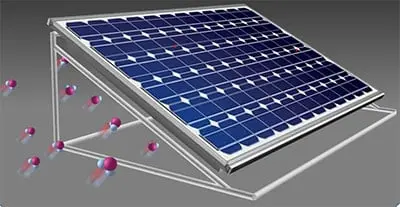 Unlike conventional surface solar panels, underwater solar energy systems must account for light scattering, wavelength absorption, pressure resistance, corrosion protection, and reduced infrared transmission through water. Because water absorbs longer wavelengths more rapidly, researchers often select semiconductor materials optimized for visible light performance.
Common semiconductor substrates and photovoltaic materials used in underwater solar energy research include:
How Underwater Photovoltaic Systems Work
Underwater photovoltaic systems operate by converting available sunlight into electrical energy using semiconductor junctions and photovoltaic conversion layers. As sunlight penetrates water, different wavelengths are absorbed at different depths, significantly affecting solar cell efficiency.
Infrared light is rapidly absorbed within the first several meters of water, while shorter visible wavelengths penetrate deeper. Because of this, underwater solar energy systems often require customized bandgap engineering and optimized semiconductor structures.
Researchers frequently use dual junction (DJ) and triple junction (TJ) photovoltaic cells because they provide higher efficiency and improved spectral absorption compared to conventional silicon solar panels.
Triple junction solar cells commonly combine:
- GaInP top junctions
- GaAs middle junctions
- Germanium bottom junctions
These multilayer semiconductor structures improve solar spectrum utilization and allow more efficient energy harvesting across multiple wavelengths.
Advantages of Underwater Solar Energy Harvesting
Underwater solar energy harvesting offers several advantages for marine power systems, autonomous underwater vehicles, offshore monitoring equipment, and remote sensing technologies.
- Renewable energy generation
- Reduced carbon emissions
- Continuous marine power supply
- Low environmental impact
- Improved energy independence
- Support for underwater robotics and sensors
Scientists are also exploring underwater solar panels for powering oceanographic instruments, underwater communication systems, and marine environmental monitoring devices.
Why GaAs and GaInP are Used for Underwater Solar Cells
Gallium arsenide (GaAs) and GaInP semiconductor materials are widely used for underwater photovoltaic research because they offer high efficiency, excellent radiation resistance, and strong visible light absorption characteristics.
Compared to standard silicon solar cells, III-V compound semiconductor solar cells provide:
- Higher photovoltaic efficiency
- Better low-light performance
- Improved spectral response
- Higher radiation resistance
- Greater thermal stability
Researchers may also optimize semiconductor bandgaps between approximately 1.8 eV and 2.3 eV to maximize underwater visible-light absorption efficiency.
Challenges of Underwater Solar Energy Systems
Although underwater photovoltaic technology shows strong potential, researchers must overcome several engineering challenges:
- Water absorption of infrared wavelengths
- Biofouling and algae growth
- Pressure resistance at depth
- Corrosion protection
- Reduced light intensity underwater
- Encapsulation and waterproofing requirements
To improve long-term reliability, underwater photovoltaic systems may use anti-algae coatings, waterproof encapsulation, optical concentrators, and specialized marine-grade electrical connections.
Applications of Underwater Solar Energy Research
Underwater solar energy systems are being developed for a wide range of scientific, industrial, and defense applications.
- Autonomous underwater vehicles (AUVs)
- Marine environmental monitoring
- Oceanographic instrumentation
- Remote underwater sensors
- Offshore energy systems
- Underwater communication platforms
- Defense and naval technologies
As photovoltaic materials and semiconductor substrate technologies continue advancing, underwater solar energy harvesting may become increasingly important for sustainable marine power systems and next-generation underwater electronics.
