
Get Your Gallium Substrate Quote FAST!
Looking for GaAs, GaN, GaN on Sapphire, GaN on SiC, or other gallium-related substrates? UniversityWafer supplies research-grade wafers for universities, national laboratories, and commercial R&D facilities worldwide.
Get Your Gallium Wafer Quote FAST! Or, Buy Online and Start Researching Today!
Gallium-Based Substrates Available
We supply a wide selection of substrates used for compound semiconductor research and manufacturing, including:
- Gallium Arsenide (GaAs)
- GaN on Sapphire
- Gallium Nitride (GaN)
- AlGaN Structures
- Silicon Carbide (SiC)
- Silicon Wafers
- Germanium (Ge)
Typical Applications for Gallium Materials
Gallium compounds are used in some of today's fastest-growing technologies because they offer excellent electrical performance, high operating temperatures, and high-frequency capabilities.
- RF and microwave devices
- Power electronics
- Compound semiconductor devices
- LEDs and laser diodes
- High-efficiency solar cells
- 5G communications
- Electric vehicles
- Defense and aerospace electronics
Need Custom Gallium Wafer Specifications?
Whether you require specific crystal orientations, diameters, thicknesses, dopants, polish options, or epitaxial structures, our engineering team can help source or manufacture substrates that meet your research requirements. Submit your specifications today for a fast quotation.
What is Gallium?
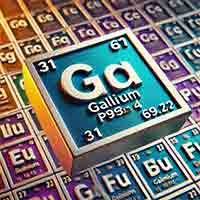 Gallium is a soft, silvery metal with the chemical symbol Ga and atomic number 31. It is best known for its low melting point, but its greatest value is in compound semiconductor materials such as gallium arsenide and gallium nitride.
These gallium-based materials are used in high-frequency electronics, LEDs, laser diodes, RF devices, solar cells, power electronics, and advanced semiconductor research.
Key Properties of Gallium
- Low melting point: Gallium melts at about 29.76°C, close to room temperature.
- Useful in semiconductors: Gallium compounds form high-performance materials for RF, optoelectronic, and power devices.
- Byproduct material: Gallium is typically recovered from bauxite and zinc processing rather than mined directly.
- Expansion on solidification: Gallium expands when it freezes, which can affect handling and storage.
How is Gallium Used in Semiconductor Research?
 Gallium is important because it forms several high-value semiconductor compounds. GaAs substrates are commonly used for RF electronics, microwave circuits, photodiodes, and high-efficiency solar cells. GaN substrates and GaN-on-sapphire wafers are used for LEDs, laser diodes, high-power transistors, and wide-bandgap power devices.
Researchers also use gallium-based wafers in optoelectronics, RF applications, power devices, and solar cell development.
Common Gallium-Based Materials
- Gallium arsenide (GaAs): Used for RF devices, microwave components, LEDs, laser diodes, and high-efficiency photovoltaic cells.
- Gallium nitride (GaN): Used for LEDs, high-electron-mobility transistors, power electronics, and 5G-related devices.
- Indium gallium nitride (InGaN): Used in blue, green, and white LED structures.
- Aluminum gallium nitride (AlGaN): Used in UV LEDs, power devices, and advanced heterostructures.
Why is Gallium Supply Important?
Gallium supply matters because many advanced technologies depend on GaAs, GaN, InGaN, and AlGaN materials. Since gallium is usually produced as a byproduct of aluminum and zinc refining, availability can be affected by mining output, refining capacity, export controls, and demand from semiconductor manufacturers.
Industries That Depend on Gallium
- Semiconductors: GaAs and GaN are used in high-speed, high-frequency, and high-power devices.
- Telecommunications: Gallium-based devices support RF amplifiers, radar, satellite systems, and 5G infrastructure.
- LED and laser manufacturing: GaN and InGaN are important for efficient light emission.
- Solar energy: GaAs solar cells are used where high efficiency and performance are required.
- Aerospace and defense: GaN and GaAs are used in radar, communications, and advanced electronics.
- Electric vehicles and power electronics: GaN power devices can improve switching speed, efficiency, and power density.
Gallium Shortage and Supply Chain Concerns
Gallium shortages can occur when demand for compound semiconductors rises faster than available supply. Export restrictions, limited refining capacity, and dependence on a small number of producing regions can make gallium difficult to source for research and manufacturing.
Because gallium is important for semiconductor, optoelectronic, RF, and power device applications, researchers often plan ahead when ordering gallium-based substrates. UniversityWafer can help source GaAs wafers, GaN on sapphire, GaN wafers, SiC wafers, and other substrates used in gallium-related device research.
Related Gallium & Semiconductor Resources
- Gallium Arsenide (GaAs) Wafers
- GaN on Sapphire
- Gallium Nitride (GaN) Wafers
- AlGaN Structures
- Indium Gallium Nitride (InGaN)
- Silicon Carbide (SiC) Wafers
- Silicon Wafers
- Germanium Wafers
- RF Applications
- Power Devices
- Optoelectronics
- Semiconductor Devices
- Solar Cell Substrates
- Graphene Substrates
- Silicon Epitaxial Wafers